About one in nine US adults now takes a GLP-1 medicine for weight loss, and their households are changing what they buy: less from the snack and sweets aisles, more yogurt, fruit and protein products. This page brings together the measured figures from surveys, purchase data and company results, and says which are measurements, which are forecasts and where sources differ. Every figure links to its source.
How many people take GLP-1 medicines?
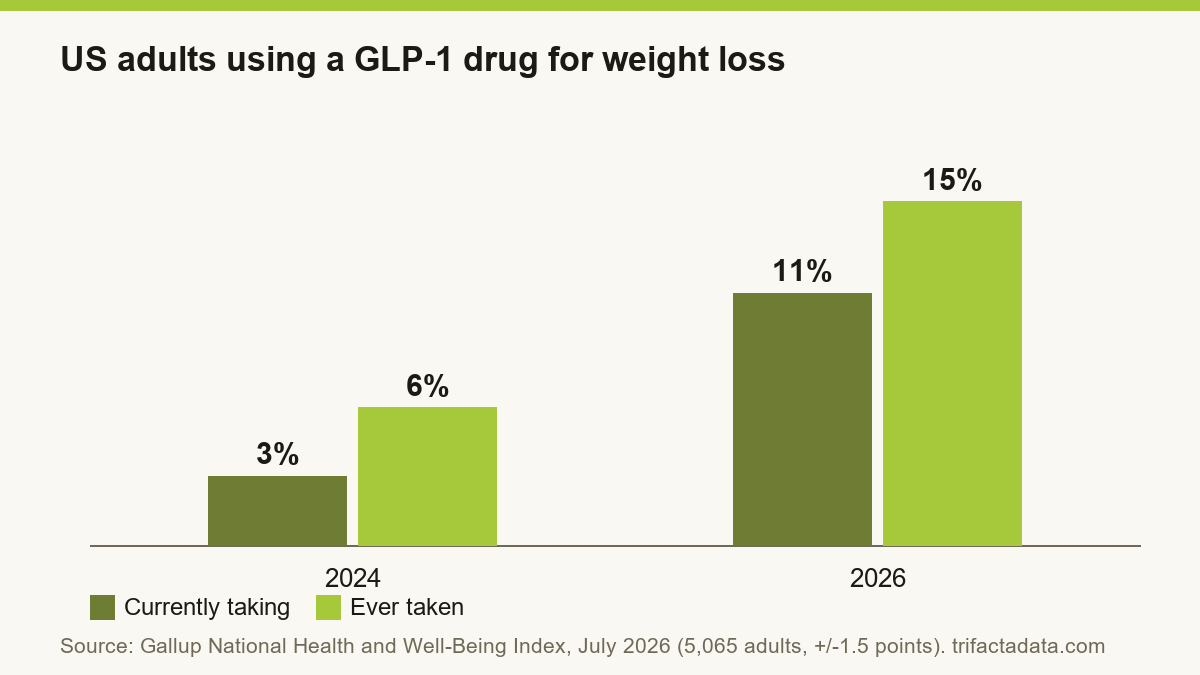
In the United States, Gallup survey of 5,065 adults (28 May to 5 June 2026) found that 11% were taking a GLP-1 drug for weight loss and 15% had ever done so, against 3% and 6% in 2024. The margin of error is 1.5 percentage points. An earlier KFF poll (27 October to 2 November 2025, 1,350 adults) counted use for any reason, including diabetes, and found 12% currently taking one and 18% ever, with the highest current use, 22%, among adults aged 50 to 64. The two surveys ask different questions, so their numbers should not be added together or treated as a trend.
Looked at by household, Circana research reported by trade press put the share of US households with a member using a GLP-1 at about 23%, which corresponds to individual use of 10% to 14%. In Great Britain, a UCL-led study estimated that about 1.6 million adults used weight-loss drugs between early 2024 and early 2025, with a further 3.3 million interested in using them.
What changes in the shopping basket
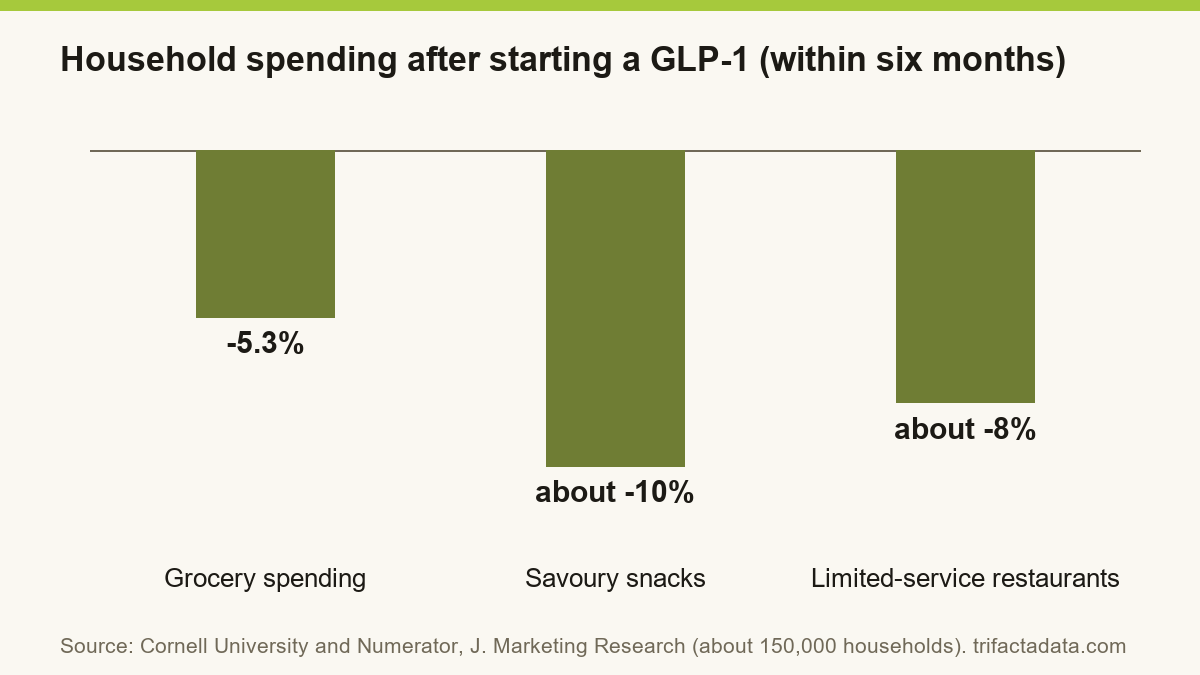
The most detailed look at purchases comes from a Cornell University study with Numerator, published in the Journal of Marketing Research that matched the grocery and restaurant records of a panel of about 150,000 households to surveys on GLP-1 use. Households that started a GLP-1 cut grocery spending by an average of 5.3% within six months, and by more than 8% among higher-income households. Savoury snacks fell by about 10% and limited-service restaurants, such as fast food and coffee shops, by about 8%. Sweets, baked goods and cookies fell by similar amounts, and so did staples such as bread, meat and eggs. Yogurt rose the most, followed by fresh fruit, nutrition bars and meat snacks.
Looking ahead, Circana has projected that households with a GLP-1 user could account for 35% of US food and beverage units by 2030. That is a forecast, not a measurement, and the assumptions behind it are not published in the trade coverage (Food Dive).
Where protein is selling
Protein is selling across formats. SPINS data show US ready-to-drink protein sales growing from USD 6.0 billion in 2023 to USD 7.6 billion in 2025, about 13% a year, with clear protein shakes up 34%, dairy-based shakes up 25% and protein waters, shots and sodas up 12% in 2025; protein supplements and meal replacements added a further USD 8.6 billion (BeverageDaily, March 2026). In dairy, Circana data quoted in a Midwest Dairy release of 23 June 2026 showed US yogurt volume up nearly 9% in 2025 and cottage cheese up nearly 15%.
Company results point the same way. BellRing Brands reported fiscal 2025 net sales of USD 2,316.6 million, up 16.1%, with Premier Protein volume up 14.6%. Danone, according to DairyReporter, said Oikos passed EUR 1 billion in US revenue in 2025, although North America was held back by capacity constraints in high-protein yogurt.
Why protein: what the guidance says
The US Dietary Guidelines for 2025 to 2030, released in January 2026, set a target of 1.2 to 1.6 grams of protein per kilogram of body weight a day for healthy adults and say high-protein foods should be prioritised at every meal. For people taking GLP-1 medicines, an Irish dietitian quoted by the Irish Independent in June 2026 advised at least 60 to 80 grams a day, spread across the day, and the same article reported an Italian study in which 88% of adults taking semaglutide or tirzepatide did not meet recommended protein levels. Needs vary from person to person; this is general information, not medical advice.
How food companies are responding
| Date | Company | What happened |
|---|---|---|
| May 2024 | Nestlé | Announced Vital Pursuit, 12 frozen meals in the United States at USD 4.99 or less, positioned as a companion for people taking GLP-1 medicines (Just Food). |
| Jan 2025 | Conagra Brands | Added a "GLP-1 friendly" badge to selected Healthy Choice frozen meals that are high in protein, low in calories and a good source of fibre. Conagra said GLP-1 users were about 7% of adult consumers and that it did not plan a separate brand (Food Dive). |
| Jan 2026 | Morrisons and Applied Nutrition | Under a three-year licence, Morrisons began selling Applied Nutrition-branded food, 53 products in about 400 UK stores, including what it called the first supermarket-exclusive range of GLP-1 friendly ready meals (Applied Nutrition announcement, 19 December 2025). |
Other makers are adding protein to everyday products. The Washington Post reported in June 2026 that General Mills had launched protein-enriched Cheerios, Kraft a protein macaroni and cheese, and Starbucks protein lattes and protein cold foam, which its finance chief described as a driver of store traffic.
What "GLP-1 friendly" does and doesn't mean
There is no legal definition. Conagra's badge reflects its own criteria of high protein, low calories and a good source of fibre. Where a food does make a protein or fibre claim, rules apply: in the European Union a "source of protein" claim needs at least 12% of the food's energy to come from protein and a "high protein" claim at least 20%, while "source of fibre" needs 3 g per 100 g (or 1.5 g per 100 kcal) and "high fibre" 6 g per 100 g (or 3 g per 100 kcal) (European Commission).
How big is the market? Why published estimates disagree
Estimates of the market range widely because the definitions differ. One publisher puts the 2025 high-protein food market at USD 53.94 billion (Value Market Research); a wider "high-protein convenience foods" scope reaches USD 77.40 billion (Data Bridge Market Research); and a narrow "GLP-1 companion foods" scope, which counts foods, drinks and supplements for people taking the medicines, is USD 2.90 billion (Meticulous Research). The figures are not comparable, which is why the scope of any market number matters more than the number itself.
Frequently asked questions
How many Americans take a GLP-1 medicine?
Gallup's mid-2026 survey found 11% of US adults taking a GLP-1 drug for weight loss and 15% having ever done so. KFF's late-2025 poll, which counts use for any reason, found 12% currently and 18% ever.
Do households with a GLP-1 user spend less on food?
Yes. A Cornell University and Numerator study found grocery spending fell by an average of 5.3% within six months of a household starting a GLP-1, with savoury snacks down about 10%.
Which foods do GLP-1 households buy more of?
The same study found yogurt rose the most, followed by fresh fruit, nutrition bars and meat snacks.
What does "GLP-1 friendly" mean on a food label?
It has no legal definition. It is a marketing position, and companies such as Conagra apply their own criteria, for example high protein, low calories and a good source of fibre.
How much protein is recommended?
The US Dietary Guidelines for 2025 to 2030 give 1.2 to 1.6 g per kg of body weight a day for healthy adults. One dietitian quoted in the Irish Independent advised at least 60 to 80 g a day for people taking GLP-1 medicines. Needs vary, so ask a dietitian or doctor.
Sources
- Gallup, "In U.S., GLP-1 Usage Reaches New High", 7 July 2026 (updated 8 September 2026)
- KFF poll on GLP-1 use, 14 November 2025
- UCL, "1.6 million UK adults used weight loss drugs in past year", January 2026
- Circana research on GLP-1 households (November 2025), reported by Food Dive
- Cornell University and Numerator, "The No-Hunger Games", Journal of Marketing Research (ScienceDaily summary, 12 January 2026)
- Midwest Dairy / PR Newswire, 23 June 2026 (quoting Circana)
- SPINS data via BeverageDaily, 15 March 2026
- BellRing Brands Q4 and fiscal 2025 results (SEC Form 8-K)
- Danone 2025 results, DairyReporter, 20 February 2026
- Conagra "GLP-1 friendly" badge, Food Dive, 16 December 2024
- Nestlé Vital Pursuit, Just Food, 21 May 2024
- Applied Nutrition plc announcement, 19 December 2025
- US Dietary Guidelines 2025-2030, American Family Physician, July 2026
- European Commission, nutrition claims
- Irish Independent, 8 June 2026; The Washington Post, 28 June 2026
- Value Market Research via GII; Data Bridge Market Research; Meticulous Research
Related reports
This page is market information, not medical advice. Figures are quoted from the sources linked above; forecasts are labelled as such.