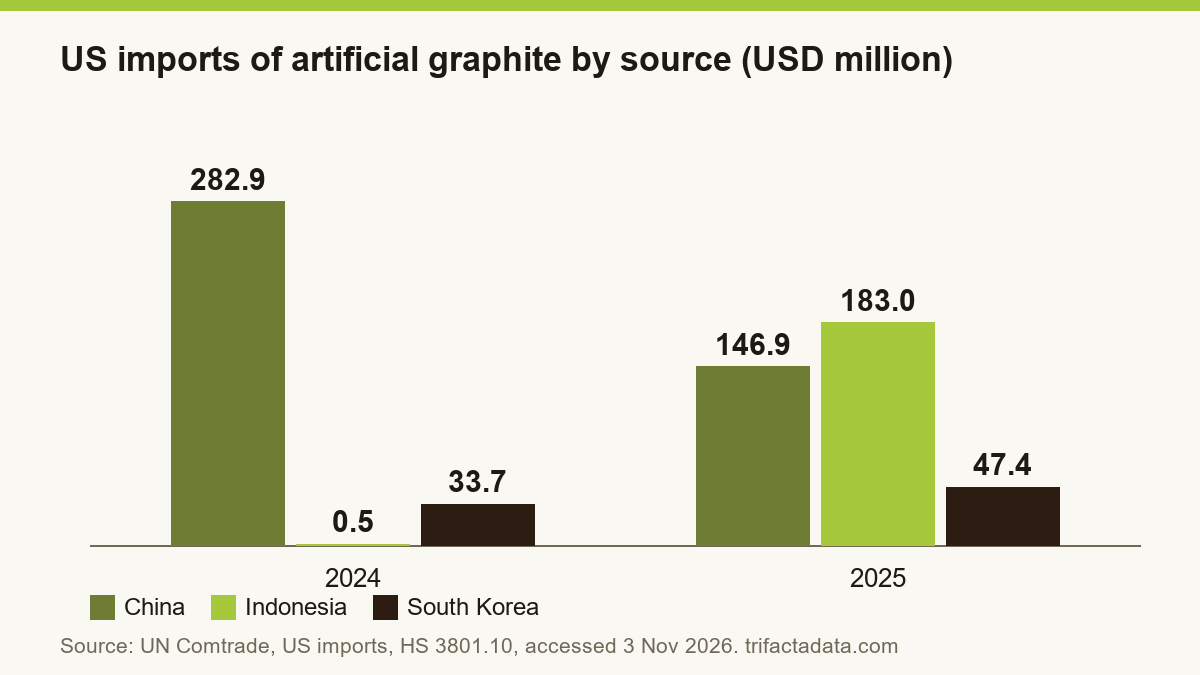
Graphite anode material, the powder that stores lithium in almost every lithium-ion battery, is one of the most concentrated supply chains in the energy transition, and one of the materials covered by China's export controls. In 2025 the United States started to buy it from somewhere else. UN trade data show US imports of artificial graphite from Indonesia rose from USD 0.5 million in 2024 to USD 183.0 million in 2025, more than the USD 146.9 million that came from China. But the largest anode plant in Indonesia belongs to BTR, the Chinese company that is the world's biggest anode maker, so most of the new supply is still Chinese-owned. Battery plants in Europe made no such switch.
Why graphite anode material matters now
Every lithium-ion battery needs an anode, and almost all anodes are made of graphite, either synthetic graphite made from petroleum or coal-tar coke, or natural flake graphite that is shaped into spheres, purified and coated. Industry data cited in the 2025 annual report of Ningbo Shanshan put world anode production at 3.115 million tonnes in 2025, of which Chinese producers made 99.0%, and world sales at 3.0615 million tonnes, of which Chinese producers sold 98.4%. The same figures appear in the annual report of Heyuan Gas. The International Energy Agency, which counts where production capacity sits, puts China's share of anode material at 93% in 2024, Korea's at 5% and Japan's at 1%.
That concentration is now a policy issue. In October 2025 China announced export controls on lithium-ion batteries and their materials, including graphite anode materials and the equipment to make them, and in November 2025 its commerce ministry suspended them until 10 November 2026. In September 2026 China confirmed that its wider trade truce with the United States would run to 10 January 2027, but no formal notice re-dating the graphite suspension has been published. The IEA describes graphite anode material as a chokepoint for which supply options outside China are extremely limited.
The US switch to Indonesia and Korea
UN Comtrade data for US imports show the shift in a single year. Total US imports of artificial graphite rose from USD 430.8 million in 2024 to USD 546.3 million in 2025, but the amount bought from China fell by almost half, while Indonesia went from almost nothing to the largest source by value. South Korea rose too, from USD 33.7 million to USD 47.4 million, and its sales of graphite preparations to the US (HS 3801.90) rose from USD 6.5 million to USD 19.0 million. Indonesian material was worth about USD 5,380 a tonne, against about USD 2,640 for material from China (calculated), which fits higher-grade anode material from Indonesia and a mix of grades from China.
The US International Trade Commission's final report on active anode material from China, published in March 2026, explains who the new suppliers are. It found that the largest sources of anode material from outside China were Indonesia and South Korea, that US buyers had recently certified BTR in Indonesia and POSCO in South Korea, and that at least one buyer increased purchases from outside China while cutting supply from China to meet US rules on foreign entities of concern. US imports of anode material from outside China rose from 13.3 million pounds in 2024 to 37.9 million pounds in the first half of 2025 alone. The Commission voted against anti-dumping and anti-subsidy duties, so the switch was driven by sourcing rules and China's own restrictions rather than by tariffs on anode material.
Diversified, but still Chinese-owned
The Indonesian supply comes largely from a Chinese company. BTR opened its anode plant in Kendal, Indonesia, in August 2024 with 80,000 t of capacity and planned a second phase to take it to 160,000 t, making it the largest anode plant outside China. Other Chinese makers are following: Putailai announced a 50,000 t plant in Malaysia in March 2026 after cancelling a project in Sweden, Zhongke Electric began building a plant of up to 200,000 t in Oman in May 2026, and BTR is building a 60,000 t plant in Morocco, according to the Trade Commission's report. Because industry data count these plants as Chinese production, China's share of anode sales barely moves when supply shifts to them.
In Europe the shift has not started. Hungary, where Korean and Chinese cell makers run large battery plants, bought USD 127.5 million of its USD 138.1 million of artificial graphite imports from China in 2025, a share of 92.3% (calculated), and another USD 48.5 million of graphite preparations from China. Poland, home to a large LG Energy Solution plant, bought USD 100.7 million of its USD 149.6 million from China, with most of the rest being lower-value grades from European suppliers.
| Importer, 2025 | Artificial graphite from China | Total artificial graphite imports | China's share (calculated) |
|---|---|---|---|
| United States | USD 146.9 million | USD 546.3 million | 26.9% |
| Hungary | USD 127.5 million | USD 138.1 million | 92.3% |
| Poland | USD 100.7 million | USD 149.6 million | 67.3% |
| United States, 2024 | USD 282.9 million | USD 430.8 million | 65.7% |
Who is building supply outside China
Korea's POSCO Future M is the main non-Chinese producer. In March 2026 it signed a five-year contract, worth about 1 trillion won, to supply synthetic graphite anode material to a global carmaker from 2027, and it is building a 357 billion won plant in Vietnam for production from 2028. In October 2026 it agreed to supply LG Energy Solution with battery materials over seven years, including synthetic graphite anodes for the first time, and on 3 November Hyundai Motor Group signed a letter of intent to consider a 100 billion won stake in the Vietnam plant in return for priority access to its output.
In the United States, projects are slower. Graphite One received its final Ohio air permit in November 2026 for a 10,000 t a year plant, with first sales targeted for the fourth quarter of 2028. NOVONIX expects mass production for Panasonic in the second half of 2027. Meanwhile China has applied its restrictions to specific buyers: in June 2026 it barred exports of dual-use items to ten US companies linked to defence, a category that covers graphite.
What to watch
The first thing to watch is whether China formally re-dates its suspended controls on anode materials before or after 10 November. The second is whether European battery plants follow the US in buying from Indonesia, Korea and Japan, and whether the Chinese-owned plants in Southeast Asia, the Middle East and North Africa count as diversification under US and European rules. The 2026 trade data will show whether Indonesia's jump in 2025 was the start of a new supply route or a one-off.
Frequently asked questions
Why did US graphite imports from Indonesia jump in 2025?
BTR, China's largest anode maker, opened a large anode plant in Indonesia in 2024, and US buyers certified it as a supplier from outside China. US rules on foreign entities of concern and China's halt to spherical graphite exports to the US pushed buyers to switch.
How much artificial graphite did the US import from China in 2025?
UN Comtrade data show US imports of artificial graphite from China fell from USD 282.9 million (85,900 t) in 2024 to USD 146.9 million (55,600 t) in 2025, while imports from Indonesia rose to USD 183.0 million (34,000 t).
What share of the world's anode material does China make?
Industry data cited in the 2025 annual reports of Ningbo Shanshan and Heyuan Gas put Chinese producers at 99.0% of world anode production and 98.4% of sales in 2025. The IEA, which counts where capacity sits, put China at 93% in 2024.
What is HS 3801.10?
It is the customs code for artificial graphite. It covers battery anode material but also other grades, such as graphite used in steelmaking, so trade figures under it indicate the anode trade rather than measure it exactly.
Sources
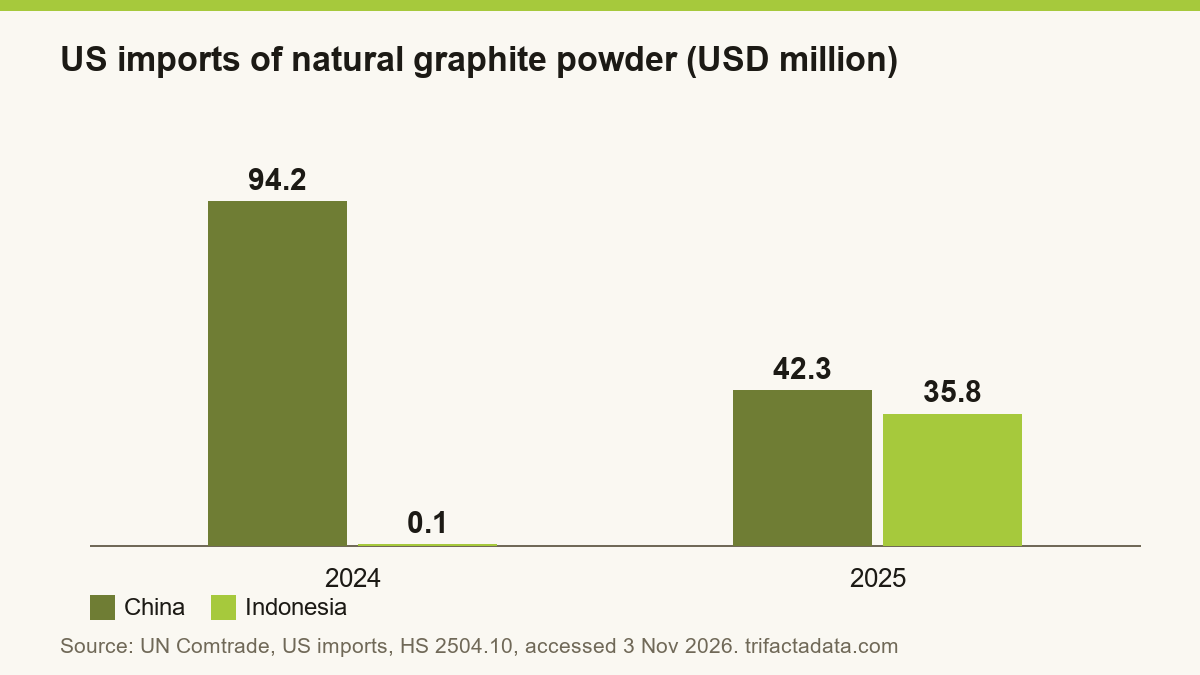
- UN Comtrade, US imports of HS 3801.10, 3801.90 and 2504.10 by partner, 2024-2025 (accessed 3 November 2026)
- UN Comtrade, Hungary and Poland imports of HS 3801.10 and 3801.90 by partner, 2024-2025 (accessed 3 November 2026)
- UN Comtrade Plus database
- US International Trade Commission, Active Anode Material from China, Publication 5719 (March 2026)
- International Energy Agency, commentary on export controls and supply concentration (23 October 2025)
- International Energy Agency, Global Critical Minerals Outlook 2026
- Ministry of Commerce and General Administration of Customs of China, Announcement No. 70 of 2025
- Plataforma Media, China confirms extension of trade truce with the US to January 2027 (28 September 2026)
- Ningbo Shanshan, 2025 annual report
- Heyuan Gas, 2025 annual report
- BTR New Material Group, Indonesian anode plant (PR Newswire, 7 August 2024)
- Yicai Global, Putailai Malaysia plant (March 2026)
- Ministry of Foreign Affairs of Oman, Zhongke Electric anode project in Sohar (May 2026)
- The Korea Times (Yonhap), POSCO Future M synthetic anode contract (16 March 2026)
- The Korea Herald, POSCO Future M and LG Energy Solution (30 October 2026)
- The Korea Herald, Hyundai and POSCO Future M Vietnam plant (3 November 2026)
- Graphite One, final Ohio air permit (PR Newswire, 2 November 2026)
- Panabee, NOVONIX sample to Panasonic (30 July 2026)
- Business Standard (Reuters), China imposes export controls on 10 US firms (22 June 2026)
Related reports
This page is market information, not investment advice. Trade figures are UN Comtrade data as reported by the importing country. HS 3801.10 (artificial graphite) and HS 2504.10 (natural graphite in powder or flakes) include battery anode material but also other grades, such as graphite for steelmaking and industrial uses, so they are an indicator of anode trade, not a direct count. Shares and changes marked as calculated are worked out by Trifacta Data.