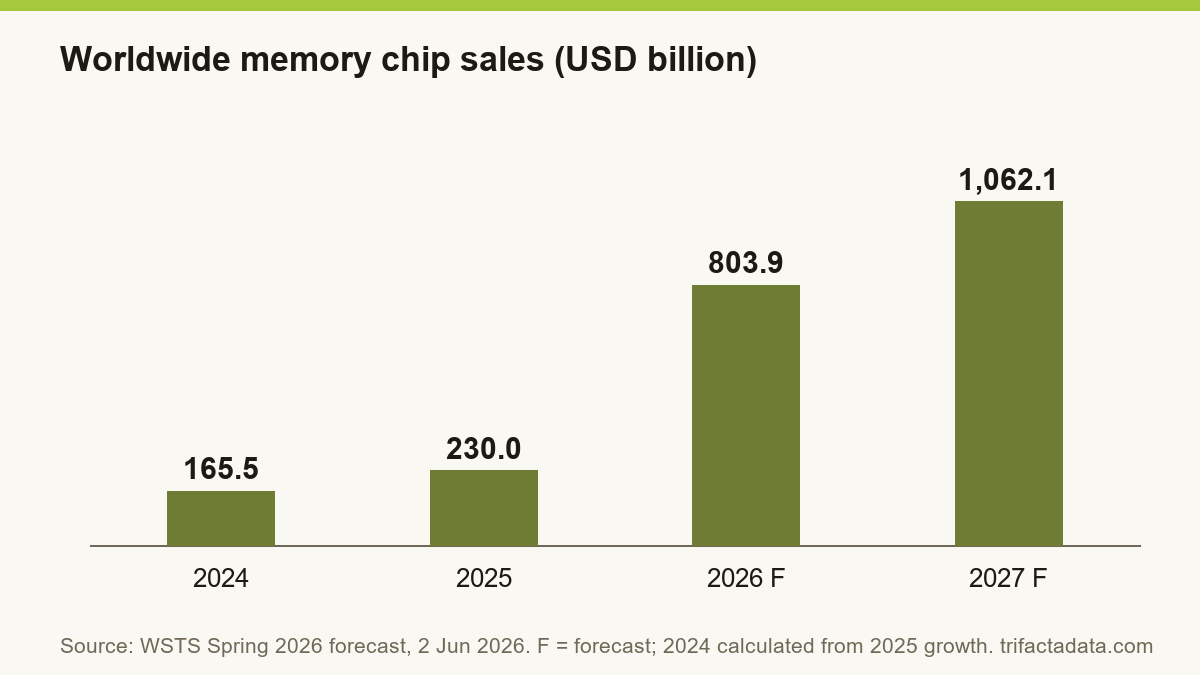
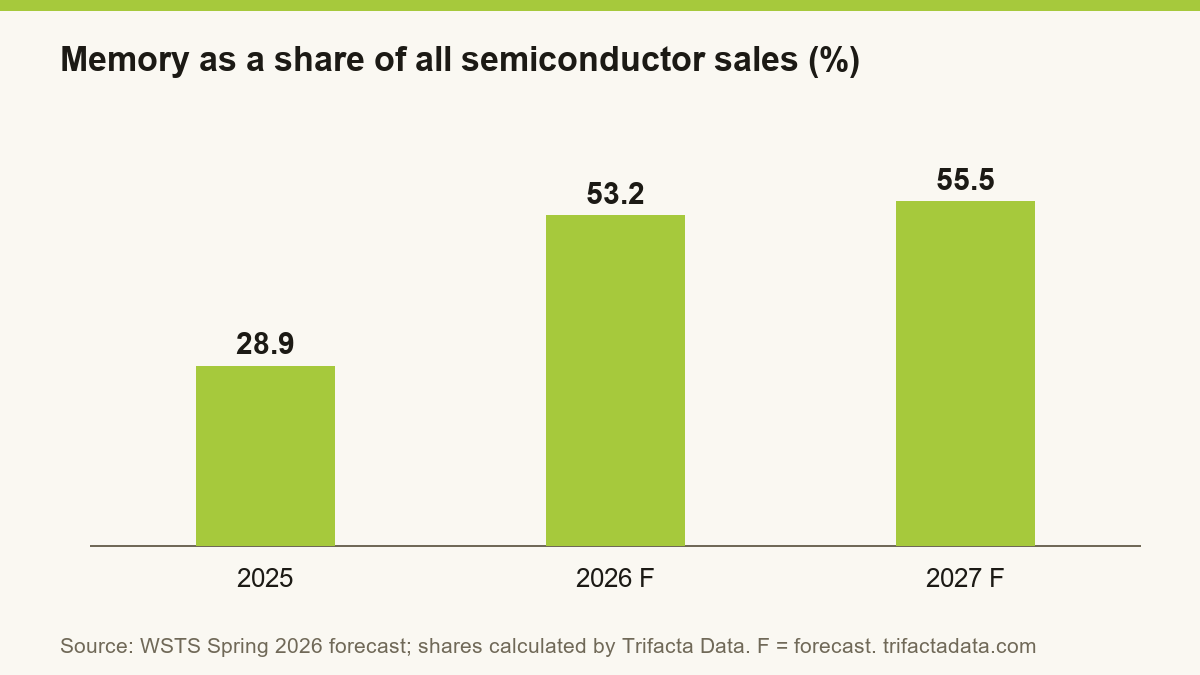
Memory chips have become the scarcest part of the chip industry. The industry's own statistics body, WSTS, recorded worldwide memory sales of USD 230.0 billion in 2025 and in June 2026 forecast USD 803.9 billion for 2026, which would make memory more than half of all semiconductor sales. The makers' filings show what is behind the jump: prices far more than volumes. Micron's revenue rose 256% in its year to 3 September 2026, with DRAM prices up about 180% while the number of bits it shipped rose in the mid-20s per cent. This page sets the official statistics and the company filings side by side, shows who is buying, and lists when new factories arrive. Every figure links to the page it came from.
How big the jump is
WSTS, the organization of semiconductor companies that publishes the industry's monthly shipment statistics, put worldwide memory sales at USD 230,042 million in 2025, up 39.0% (from about USD 165.5 billion in 2024, calculated from that growth). Its Spring 2026 forecast, released on 2 June 2026, raised the outlook sharply: USD 803,941 million in 2026, up 249.5%, and USD 1,062,085 million in 2027, up 32.1%. WSTS said that continued demand for AI infrastructure, high-bandwidth memory (HBM) and accelerated computing was the main reason. Both later years are forecasts.
The same release shows how memory is changing the shape of the whole chip industry. Memory was 28.9% of all semiconductor sales in 2025 (USD 230.0 billion of USD 795.6 billion, calculated); on the forecast it becomes 53.2% in 2026 and 55.5% in 2027. Logic chips, the next largest group, are forecast to grow 37.3% in 2026, a fast rate in any other year.
Prices did most of the work
Micron, one of the three companies that make most of the world's DRAM, explains its revenue in its annual report on Form 10-K. In the fiscal year to 3 September 2026 its revenue was USD 133.2 billion, against USD 37.4 billion a year earlier and USD 25.1 billion the year before that. Sales of DRAM rose 252% "primarily due to an approximate 180% increase in average selling prices and a mid-20% range increase in bit shipments"; NAND sales rose 274% on prices up about 200% and bit shipments again up in the mid-20s per cent. In the previous year the pattern was already visible in DRAM (prices up in the low 40s per cent, bits up in the mid-teens), while NAND grew on volume alone.
| Micron, fiscal year | DRAM, USD billion | NAND, USD billion | Total revenue, USD billion | Gross margin |
|---|---|---|---|---|
| 2024 | 17.6 | 7.2 | 25.1 | 22% |
| 2025 | 28.6 | 8.5 | 37.4 | 40% |
| 2026 | 100.7 | 31.8 | 133.2 | 81% |
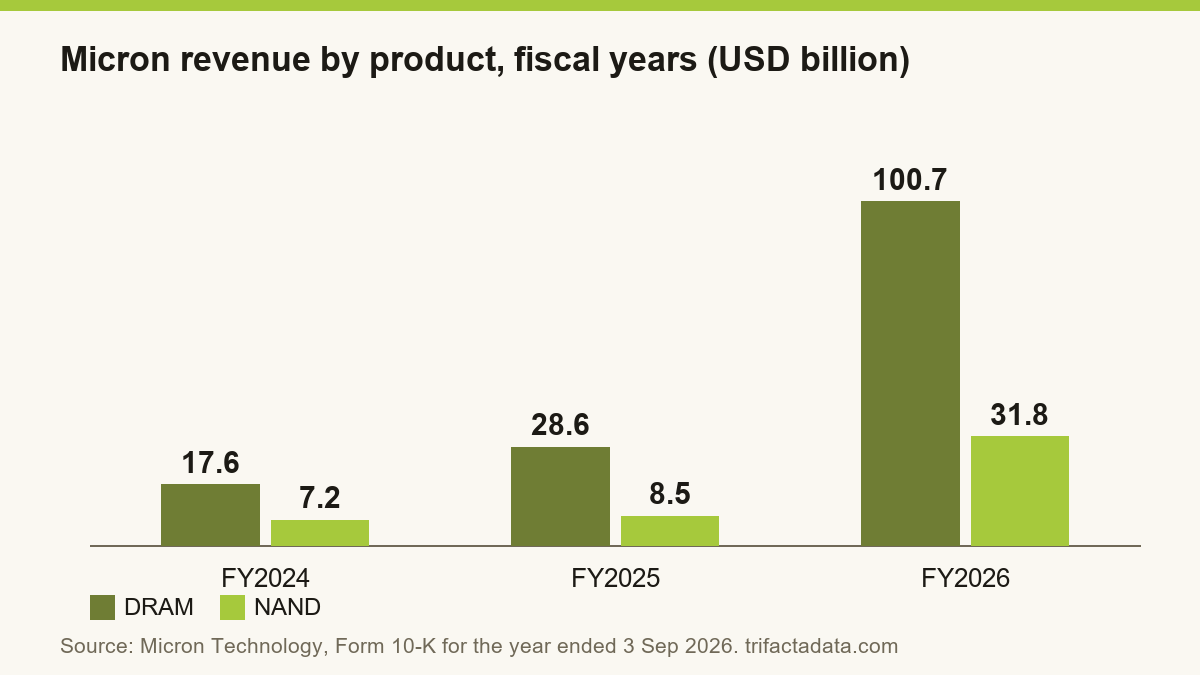
Micron's filing gives the reason in one line: "AI-driven memory and storage demand growth is outpacing industry supply", which, it says, "has led to decisions on supply allocation that may impact certain customers and end markets". Its gross margin went from 22% in fiscal 2024 to 81% in fiscal 2026.
Who is buying
Data centers are now the largest customers. Micron's two data center units, one for large cloud companies and HBM, one for other data center and enterprise customers, earned USD 80.7 billion of its USD 133.2 billion in fiscal 2026 (60%, calculated). Its mobile and client unit grew 209%, but on prices, "partially offset by lower bit shipments as MCBU product supply was redirected to other business units": phones and PCs received fewer bits so that servers could have more.
| Micron business unit, fiscal 2026 | Revenue, USD billion | Share | Change on fiscal 2025 |
|---|---|---|---|
| Cloud memory (hyperscale cloud, HBM) | 43.1 | 32% | +219% |
| Core data center (SSDs, enterprise and OEM servers) | 37.6 | 28% | +420% |
| Mobile and client (phones, PCs) | 36.6 | 27% | +209% |
| Automotive and embedded | 15.9 | 12% | +234% |
SK hynix's prospectus for its US listing, with audited 2025 accounts, shows the same pull. Its 2025 revenue was KRW 97.1 trillion, up 46.8% (calculated); DRAM was 77% of it and NAND 21%. By the location of the selling company, 68.8% of 2025 sales were booked in the United States and 19.7% in China, and its largest single customer accounted for 23.9% of revenue. In the first quarter of 2026 its revenue was KRW 52.6 trillion, almost three times the KRW 17.6 trillion of a year earlier.
What the other makers report
SK hynix reported second-quarter 2026 revenue of KRW 79.3 trillion, up 257% on a year earlier, and an operating margin of 76%, led by HBM, AI server DRAM and enterprise SSDs. Samsung Electronics estimated on 8 October 2026 a record operating profit of KRW 107.4 trillion for July to September, up 782.5%, on revenue of KRW 195 trillion; it gives a breakdown by business only with its full results on 29 October.
China's largest DRAM maker, CXMT, reported 2025 revenue of RMB 61.8 billion, up 155.6%, in its listing documents. After listing on Shanghai's STAR Market on 27 July 2026, it estimated revenue of RMB 265 to 270 billion and net profit of RMB 131 to 132.5 billion for the first nine months of 2026, against a loss a year earlier, as reported by Cloud News. Those are the company's own preliminary estimates.
Why supply cannot catch up quickly
HBM is the first reason. It stacks DRAM dies on top of each other, and the makers have moved factory space to it as AI accelerators need more of it: Samsung began mass production and shipments of HBM4 in February 2026 and expects its HBM revenue to more than triple this year, and SK hynix began mass shipments of HBM4 in the second quarter. The second reason is that new factories take years. Micron's 10-K and SK hynix's results give these dates:
| New capacity | Maker | Expected |
|---|---|---|
| HBM advanced packaging, Singapore | Micron | Early 2027 |
| First cleanroom, Yongin cluster, Korea | SK hynix | Early 2027 |
| First DRAM wafer output, Boise, Idaho | Micron | Mid-2027 |
| Acquired fab, Tongluo, Taiwan (from PSMC, March 2026) | Micron | Meaningful shipments from mid-2027 |
| Additional NAND wafer fab, Singapore | Micron | Second half of 2028 |
| Second Idaho fab, initial wafer output | Micron | Late 2028 |
| New cleanroom, Hiroshima, Japan | Micron | Late 2028 |
| First fab, Clay, New York | Micron | 2030 |
What changes for buyers
Buyers are being asked to commit for years. Micron says that in the third and fourth quarters of fiscal 2026 it entered into "strategic customer agreements" structured as take-or-pay contracts "with binding commitments for specific volumes over the multi-year contract terms", most with prices set within minimum and maximum bands; SK hynix said in July that it had finalised long-term agreements with around ten customers. Device makers passed costs on: in January 2026 PCWorld reported that Lenovo, Dell, HP, Acer and Asus had warned customers of price rises of 15 to 20%.
What is still uncertain
First, 2026 and 2027 are forecasts, and in a market moving this fast two forecasts made a few months apart can differ widely. Second, most of the new capacity above starts between 2027 and 2028, and Micron's own filing warns that average selling prices for its products "could decline materially"; the multi-year agreements are meant to soften a fall, but have not yet been tested. Third, investors have grown cautious: on 22 October 2026 SK hynix dropped plans for a US listing of its SSD unit Solidigm, which had been exploring funding for more capacity, citing market conditions. Fourth, CXMT has said it will launch server memory using a denser cell design before the end of 2026; Gulf News noted that the claim had not been independently substantiated.
Frequently asked questions
How big is the memory chip market in 2026?
WSTS, the semiconductor industry's statistics body, forecast in June 2026 that memory sales would reach USD 803.9 billion in 2026, up 249.5% from USD 230.0 billion in 2025, and USD 1,062.1 billion in 2027. Both later figures are forecasts.
Why are DRAM prices so high in 2026?
Demand from AI data centers for HBM, server DRAM and enterprise SSDs is growing faster than supply, and makers have moved factory space to those products. Micron's 10-K says its DRAM sales rose 252% in the year to September 2026, primarily on average selling prices up about 180%, while bit shipments rose in the mid-20s per cent.
Who is buying most of the memory?
Data centers. Micron's two data center units earned 60% of its fiscal 2026 revenue, and SK hynix booked 68.8% of its 2025 sales through its US selling entities, with one customer accounting for 23.9% of revenue.
When will the memory shortage end?
No filing gives a date. New factories start between 2027 and 2028: Micron's first Idaho DRAM fab in mid-2027 and its second in late 2028, SK hynix's Yongin cleanroom in early 2027. Micron's filing warns that its average selling prices could decline materially.
What are take-or-pay memory agreements?
Multi-year contracts in which customers commit to buy specific volumes; Micron says most of its agreements have prices within minimum and maximum bands. They give buyers assured supply and makers more predictable revenue.
Sources
- WSTS, Global Semiconductor Market Surges Beyond USD 1.5 Trillion in 2026 (Spring 2026 forecast), 2 Jun 2026
- Micron Technology, Inc., Form 10-K for the fiscal year ended 3 Sep 2026
- SK hynix Inc., prospectus (Form 424B4), Jul 2026, with audited 2025 financial statements
- StorageNewsletter, SK hynix fiscal 2Q26 financial results, 30 Jul 2026
- The Korea Times, Samsung Electronics first Korean firm to top W100 tril. in quarterly operating profit, 8 Oct 2026
- Asia Economy, Samsung first to mass-produce and ship HBM4, 12 Feb 2026
- Shanghai Stock Exchange (Global Times), CXMT passes IPO review, May 2026
- Cloud News, CXMT expects nearly $20 billion in nine-month profit on DRAM boom, Oct 2026
- PCWorld, Computer prices could go up by 20% due to RAM shortage, PC makers warn, 5 Jan 2026
- Investing.com, SK Hynix scraps Solidigm IPO plans citing market conditions, 22 Oct 2026
- Gulf News, China chip claim rattles Samsung and SK Hynix: what is the 4F² breakthrough?, 13 Oct 2026
Related reports
This page is market information, not investment advice. Figures are quoted from the sources linked above and keep their own definitions: WSTS figures are calendar years, Micron's are fiscal years ending in late August or early September, and Korean and Chinese figures are in won and yuan. Shares and growth rates marked as calculated are worked out by Trifacta Data from those figures. 2026 and 2027 WSTS figures are forecasts.