In 2024 the Chinese rare earth magnet makers whose reports give both tonnes and revenue realised between RMB 218 and RMB 642 for each kilogram they sold, a spread of almost three to one. China's customs data put the average price of its exports at USD 48.04 a kilogram in 2025 on 57.4 thousand tonnes shipped, 2.5% lower than in 2024, while the rare earth metal used in the magnets rose in price. This page sets those figures side by side, shows what the makers' own reports say about product mix and raw material costs, and explains why any market-size figure has to say what it counts. Every figure links to the page or file it came from.
What China exported
China's customs statistics database records exports of rare earth permanent magnets under code 85051110. The query results show 58,142,373 kilograms worth USD 2,866,077,902 in 2024, an average of USD 49.29 a kilogram, and 57,401,342 kilograms worth USD 2,757,473,059 in 2025, an average of USD 48.04. Over the year the volume fell by 1.3%, the value by 3.8% and the unit value by 2.5% (all calculated by Trifacta Data). The International Energy Agency's April 2026 report gives the same volume for 2025, 57 thousand tonnes.
| Exports, code 85051110 | Tonnes | Value, USD | USD a kilogram |
|---|---|---|---|
| 2024 | 58,142 | 2,866,077,902 | 49.29 |
| 2025 | 57,401 | 2,757,473,059 | 48.04 |
| Change | -1.3% | -3.8% | -2.5% |
The path within 2025 was uneven. Ningbo Yunsheng's half-year report, citing China Customs, said that rare earth magnet export volume fell 18.9% in the first half of 2025 compared with a year earlier. The full-year file used here shows a fall of only 1.3%, so the second half must have recovered; the two figures may not cover exactly the same product codes. Zhong Ke San Huan's 2025 annual report describes the policy background: in April 2025 China's commerce ministry and customs authority announced export controls on seven medium and heavy rare earths (samarium, gadolinium, terbium, dysprosium, lutetium, scandium and yttrium) and related items, further measures followed in October, and in November the October measures were suspended until 10 November 2026.
What makers charged in 2024
Chinese listed makers report both the tonnes of magnets they sold and the revenue from them, which makes a price per kilogram possible. For seven of them the figures below come from a table in an Oriental Securities research report that draws on their annual reports; for Zhong Ke San Huan, which the table leaves out, they come from its own 2025 annual report: 10,088 tonnes sold in 2024 for magnet revenue of RMB 6,478 million. The price is revenue divided by tonnes, calculated by Trifacta Data, and the dollar column assumes 7.2 yuan to the dollar.
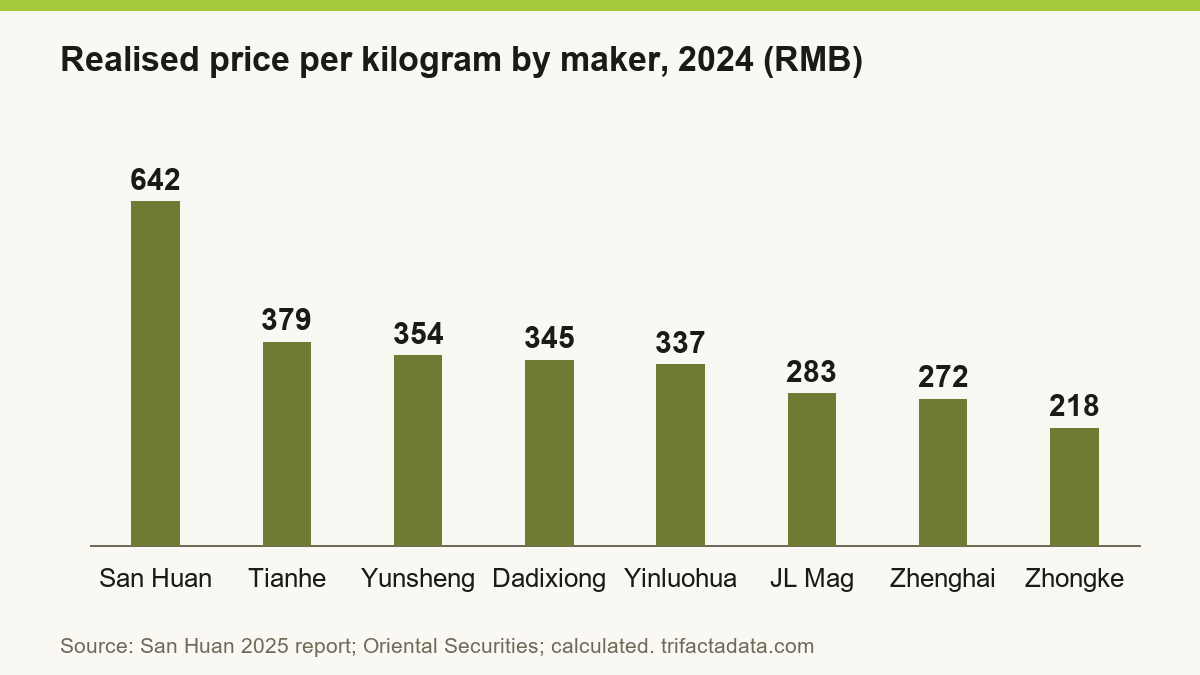
| Maker, 2024 | Tonnes sold | Magnet revenue, RMB billion | RMB a kilogram | USD a kilogram (at 7.2) |
|---|---|---|---|---|
| Zhong Ke San Huan | 10,088 | 6.48 | 642 | 89.2 |
| Tianhe Magnets (天和磁材) | 6,239 | 2.37 | 379 | 52.7 |
| Ningbo Yunsheng | 12,873 | 4.56 | 354 | 49.2 |
| Dadixiong (大地熊) | 3,233 | 1.12 | 345 | 48.0 |
| Yinluohua (英洛华) | 6,284 | 2.12 | 337 | 46.8 |
| JL Mag | 20,850 | 5.91 | 283 | 39.3 |
| Zhenghai (正海磁材) | 20,166 | 5.49 | 272 | 37.8 |
| Zhongke Magnetics (中科磁业) | 1,183 | 0.26 | 218 | 30.3 |
The highest price is 2.9 times the lowest (calculated). The sources explain part of the gap but not all of it. Oriental Securities says that makers with more sales of consumer electronics and industrial motor products, which carry higher unit prices, keep higher prices and gross profit per tonne. Ningbo Yunsheng's first-half 2025 report splits its magnet sales by market: new-energy vehicles RMB 1.147 billion, consumer electronics RMB 0.540 billion and industrial and other uses RMB 0.389 billion. The grade of magnet matters too: in JL Mag's 2021 prospectus, Frost & Sullivan defined high-performance sintered NdFeB as magnets whose intrinsic coercivity in kilo-oersteds plus maximum energy product in mega-gauss-oersteds is above 60, and San Huan's 2020 report says it can supply products with that sum above 75 and working temperatures above 200 degrees Celsius. None of these reports gives a price by grade, so this page does not.
What changed in 2025
JL Mag's annual results for 2025 give principal-business revenue of RMB 7,028.1 million on 25,282 tonnes sold, RMB 278 a kilogram, against RMB 283 in 2024, a fall of 1.9% (calculated), in a year when JL Mag reported that NdPr metal averaged RMB 601,300 a tonne, up 23.8%. San Huan sold 12,610 tonnes in 2025, 25% more than in 2024, for RMB 6,377 million of magnet revenue: RMB 506 a kilogram, down 21% on RMB 642. Its report does not say why; it notes only that stocks of magnets rose by 66% because more goods were in transit. In the first half of 2025 Ningbo Yunsheng sold 6,442 tonnes of finished magnets for main-business revenue of RMB 2,076.3 million, RMB 322 a kilogram, or RMB 281 if the roughly RMB 266 million of magnet assemblies in that revenue is excluded (the report does not say whether assemblies are in the tonnage).
| Maker, 2025 | Tonnes sold | RMB a kilogram | Share of revenue earned overseas |
|---|---|---|---|
| Zhong Ke San Huan | 12,610 | 506 | 49.4% |
| Ningbo Yunsheng, first half | 6,442 | 322 (281 without assemblies) | 29.5% |
| JL Mag | 25,282 | 278 | 16.5% |
The makers that sell more abroad also realise more per kilogram, and China's customs average of USD 48.04 a kilogram (about RMB 346 at 7.2) sits between San Huan and JL Mag. Three makers are too few to show that one causes the other, and overseas sales mix with product mix.
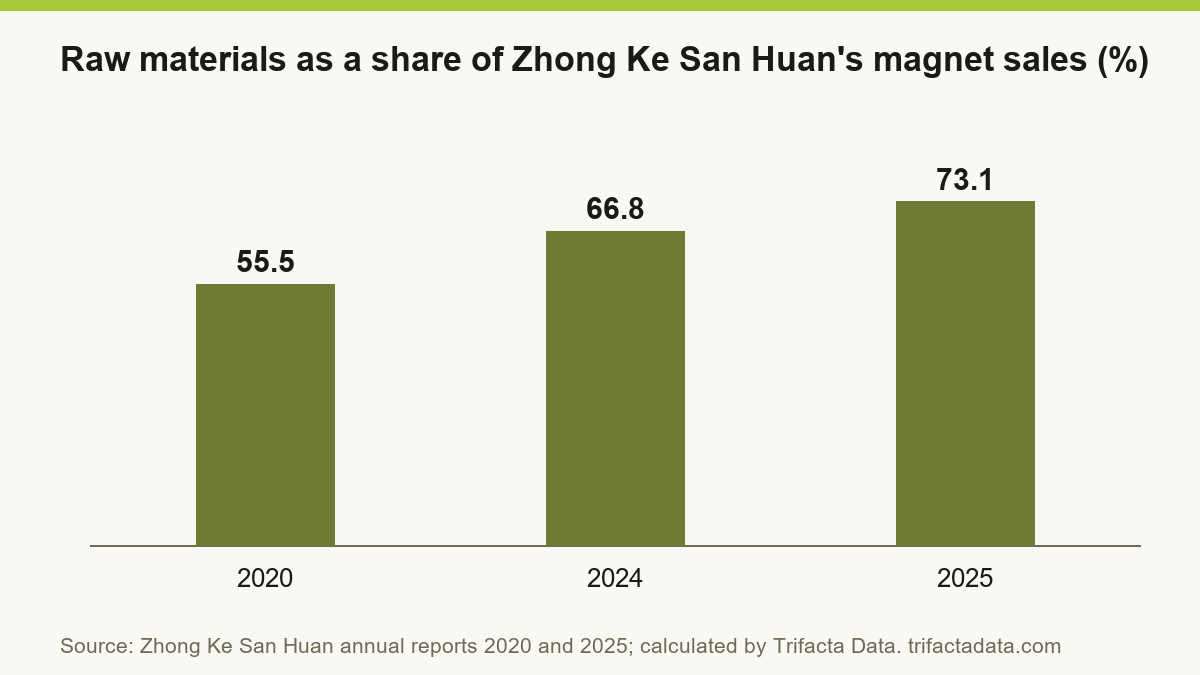
Raw materials are the largest cost. In San Huan's reports they were RMB 2.46 billion in 2020 (63.8% of the cost of magnet sales, 55.5% of magnet revenue), RMB 4.33 billion in 2024 and RMB 4.66 billion in 2025 (78.7% of cost and 73.1% of revenue; shares of revenue calculated). Its gross margin on magnets was 12.9% in 2020 and 11.2% in 2025. The rise in raw materials' share is consistent with dearer rare earths and a richer mix of heavy rare earth content, but the reports do not break the change down, so this page does not either.
Why a market size depends on what is counted
A market size is a price multiplied by a quantity. A Research and Markets listing of an Expert Market Research report published in August 2025 puts the global rare earth magnet market at USD 21.99 billion in 2024; the listing shows no method or scope. At China's 2025 export price of USD 48.04 a kilogram that value would need about 458 thousand tonnes, roughly eight times China's exports of 57.4 thousand tonnes and 18 times the 25,282 tonnes JL Mag sold in 2025; at the highest price in this page, San Huan's USD 89 a kilogram in 2024, it would still need about 247 thousand tonnes (all calculated by Trifacta Data). That does not make the listing wrong: a market size can include magnet assemblies, motors or other scopes. It shows why a size should be read together with its definition, its tonnes and its price per kilogram.
What is still uncertain
First, the figures are not like for like. Each price is revenue divided by tonnes; revenue can include assemblies, by-products and bonded magnets, and tonnes may be counted differently by different makers. Second, seven of the eight 2024 prices come from a broker's table of annual-report data and not from the reports themselves, and the table covers listed makers only: it does not include the smaller Chinese makers or those in Japan, Europe or the United States. Third, the customs price is for one product code and the maker prices are for each maker's own mix. Fourth, the dollar prices use an assumed rate of 7.2 yuan to the dollar. Finally, San Huan's first-half and full-year figures, Yunsheng's half-year report and the 2025 export figures are as reported and have not been audited by us. This page is market information, not investment advice.
Frequently asked questions
How much did China export in rare earth magnets in 2025?
China's customs statistics (code 85051110) show 57,401 tonnes worth USD 2.76 billion in 2025, against 58,142 tonnes worth USD 2.87 billion in 2024: volume down 1.3% and value down 3.8%.
What does a kilogram of rare earth magnet cost?
It depends on the maker and the mix. China's customs average was USD 48.04 a kilogram in 2025. In 2024 listed makers realised from RMB 218 to RMB 642 a kilogram, and in 2025 JL Mag realised RMB 278 and Zhong Ke San Huan RMB 506.
Why do magnet prices differ so much between makers?
The sources point to product mix: Oriental Securities says makers with more consumer electronics and industrial motor sales keep higher prices, and the grade of magnet matters. No report in this page gives a price by grade, so the size of each effect is not known.
Did magnet prices follow rare earth prices up in 2025?
Not in the figures here. JL Mag reported that NdPr metal averaged RMB 601,300 a tonne in 2025, up 23.8%, while its own realised price fell 1.9% and China's export unit value fell 2.5%. San Huan's price fell 21% and the reports do not say why.
Why do published market sizes for rare earth magnets differ?
They may count different things, such as magnets only or magnets with assemblies and motors, and they rarely show tonnes or price per kilogram. A listed USD 21.99 billion estimate for 2024 would need about 458 thousand tonnes at China's 2025 export price, against 57.4 thousand tonnes exported.
Sources
- China customs statistics database, exports of rare earth permanent magnets (code 85051110), 2024 and 2025 (query files supplied by the user)
- Zhong Ke San Huan High-Tech Co., Ltd. (000970.SZ), 2025 annual report and summary (Chinese)
- Zhong Ke San Huan High-Tech Co., Ltd., 2020 annual report and summary (Chinese)
- JL Mag Rare-Earth Co., Ltd. (HKEX 6680), announcement of annual results for 2025
- JL Mag Rare-Earth Co., Ltd., prospectus dated 31 December 2021 (industry overview by Frost & Sullivan)
- Ningbo Yunsheng Co., Ltd. (600366.SH), 2025 half-year report (Chinese)
- Oriental Securities, first-coverage report on JL Mag (300748.SZ), 2025 (Chinese), citing company annual reports
- International Energy Agency, Rare Earth Elements: Pathways to secure and diversified supply chains (April 2026)
- Research and Markets, Rare Earth Magnet Market Size and Share Outlook 2025-2034 (listing)
Related reports
This page is market information, not investment advice. Figures are quoted from the sources linked above; prices per kilogram and shares marked as calculated are worked out by Trifacta Data from reported revenue and tonnes, and dollar amounts for makers assume 7.2 yuan to the dollar.