The Middle East is one of the world's largest buyers of black tea, and three of the biggest exporters, Kenya, Sri Lanka and India, sell a large part of their crop there. When the war that followed the United States and Israeli strikes on Iran began at the end of February 2026, shipping to the Gulf was disrupted, war-risk insurance lapsed and payments stalled. Sri Lankan exporters estimated their losses at USD 10 to 15 million a week, Kenyan tea already sold to buyers was left at the Port of Mombasa, and Kenya's exports to Iran fell 40.7% in the first quarter. Prices moved differently at each auction, and on World Bank data the average was lower in September 2026 than a year earlier. This page sets out what the trade bodies and official statistics show, country by country, with every figure linked to its source.
Why the Middle East matters to tea
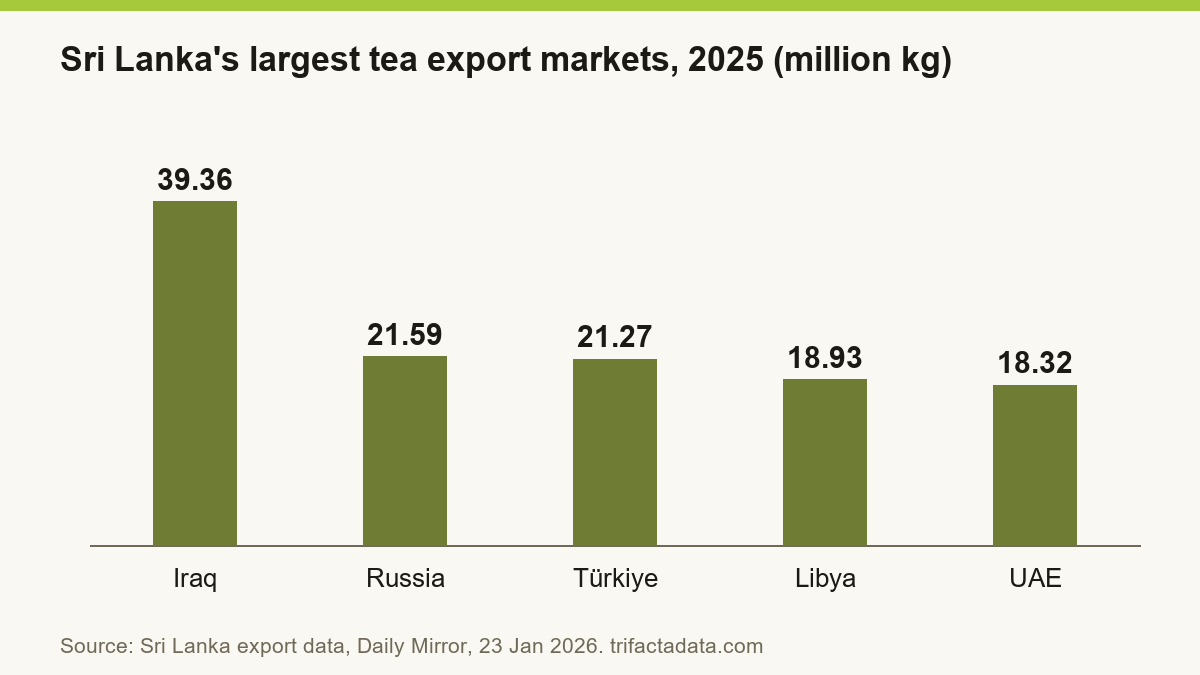
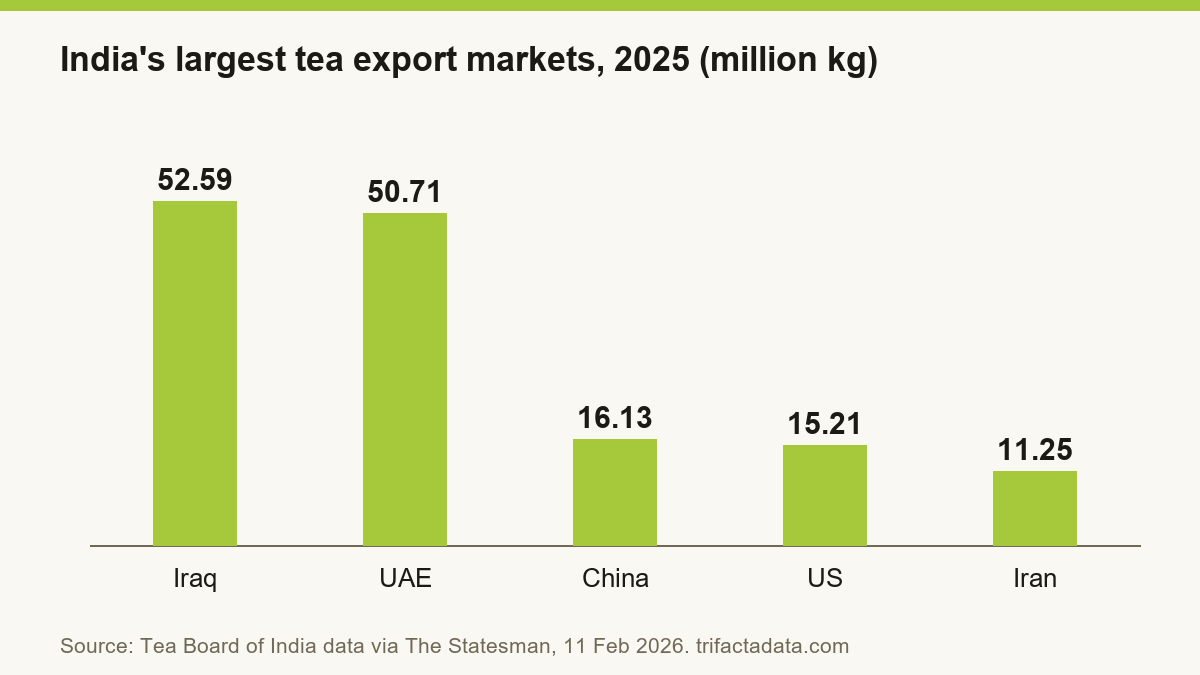
Black tea is drunk in large quantities across Iraq, Iran, the Gulf states, Libya and Egypt, and these countries buy most of it from South Asia and East Africa. Sri Lanka's exports in 2025 totalled 257.44 million kg worth more than USD 1.5 billion, and its largest buyer was Iraq, at 39.36 million kg, with Libya and the United Arab Emirates also in the top five, according to export data reported by the Daily Mirror. India exported a record 280.40 million kg in 2025, worth Rs 8,488.43 crore, and its two largest buyers were Iraq (52.59 million kg) and the UAE (50.71 million kg), with Iran fifth, on Tea Board of India provisional data. Industry sources quoted there say much of Iran's tea arrives through the UAE, so its true demand is higher than the figure shows.
Kenya, the largest exporter of black tea, depends less on the Gulf itself: its biggest buyers in 2025 were Egypt (90.70 million kg, 13.9% of exports), the United Kingdom, the UAE, Russia and Kazakhstan, on the Tea Board of Kenya's 2025 report. But much of its tea passes through the Middle East on its way to Pakistan and Central Asia, so shipping routes matter as much as buyers.
Sri Lanka: half its exports exposed
On 6 March 2026 Sri Lanka's Tea Exporters Association said the industry was losing about USD 10 to 15 million a week, reported by Ada Derana. Orders were in hand, but major shipping lines had suspended services to the region, both the Strait of Hormuz and the Red Sea route were being avoided, existing insurance cover was no longer valid and freight had risen by about USD 1,800 for a 20-foot container and USD 3,000 for a 40-foot container. About 52% of Sri Lanka's tea exports go to the Middle East, about 125 million kg worth an estimated USD 750 million in 2025. At that week's auction, prices fell about Rs 50 a kg overall and about Rs 75 a kg for low-grown teas, which smallholders grow.
Iran was a particular problem. It buys about 11 million kg a year from Sri Lanka under a barter arrangement, and about USD 50 million was still owed for tea already shipped, the association said. Its January 2026 export earnings had been USD 121.8 million, up 5% on a year earlier, before the war began.
Kenya: tea stuck at Mombasa
In Kenya the problem was tea that had been sold but could not leave. The East African Tea Traders Association said on 26 March 2026 that the sector had lost an estimated KSh 3.1 billion in foregone business as consignments sat at the Port of Mombasa, and its director put the losses at about USD 8 million a week, reported by Citizen Digital. About 40% of Kenya's tea market is in Pakistan and about 20% of its leaf tea goes to the UAE, the association said, and the country's export promotion agency urged exporters to look for new buyers in Africa.
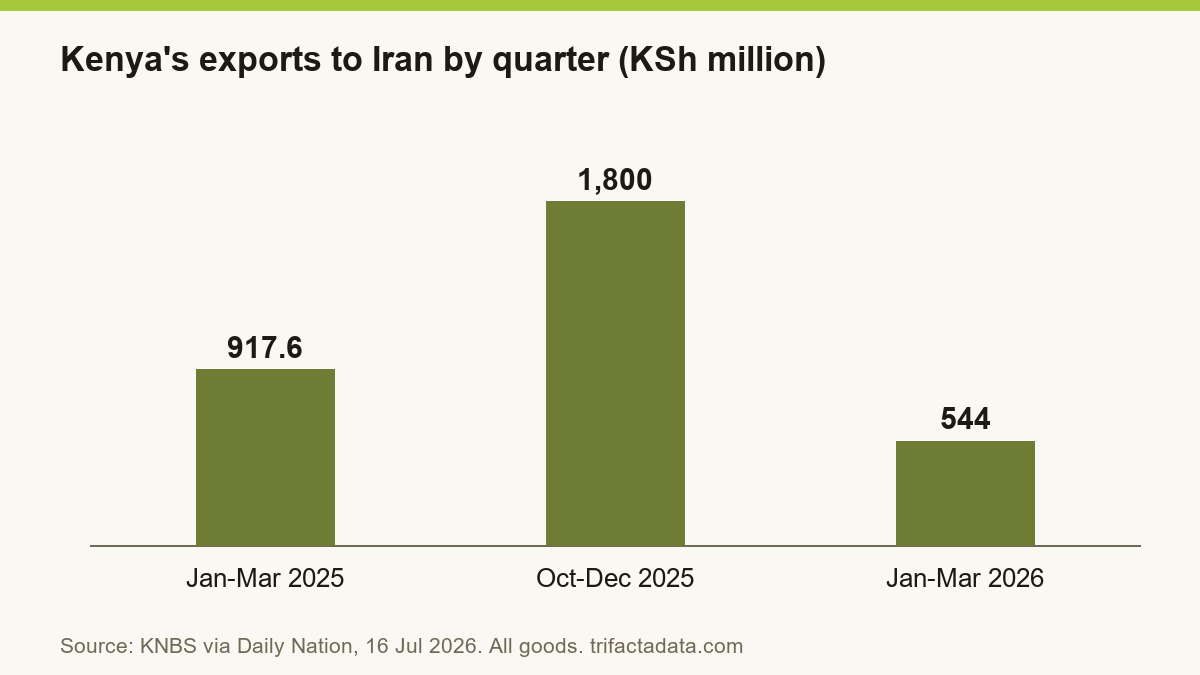
Official statistics later showed the scale of the hit to Iran. Kenya's exports to Iran fell to KSh 544 million in the three months to March 2026 from KSh 917.6 million a year earlier, a fall of 40.7%, and were 69.7% below the KSh 1.8 billion of October to December 2025, on Kenya National Bureau of Statistics data reported by the Daily Nation. The figures cover all goods; Iran is a long-standing buyer of Kenyan tea.
India: lower exports, higher prices
India's exports fell too. Shipments in January to March 2026 were 54.69 million kg, against 69.24 million kg a year earlier, and West Asian countries such as Iraq, the UAE and Iran take 46% of India's tea exports, according to a Business Standard report summarised by VisionIAS on 3 June 2026. Exporters were using longer and costlier routes that combine sea and road transport.
But prices rose. With supply from the region short and Sri Lanka's production lower, demand for Indian orthodox tea picked up: the average price of orthodox tea rose from Rs 315.26 to Rs 330.61 a kg between April and May 2026, on Calcutta Tea Traders Association data, as merchant exporters built up stocks and some importers paid in advance to secure supply. Industry experts quoted in the report expected the market to favour sellers until at least August.
What it means for tea prices
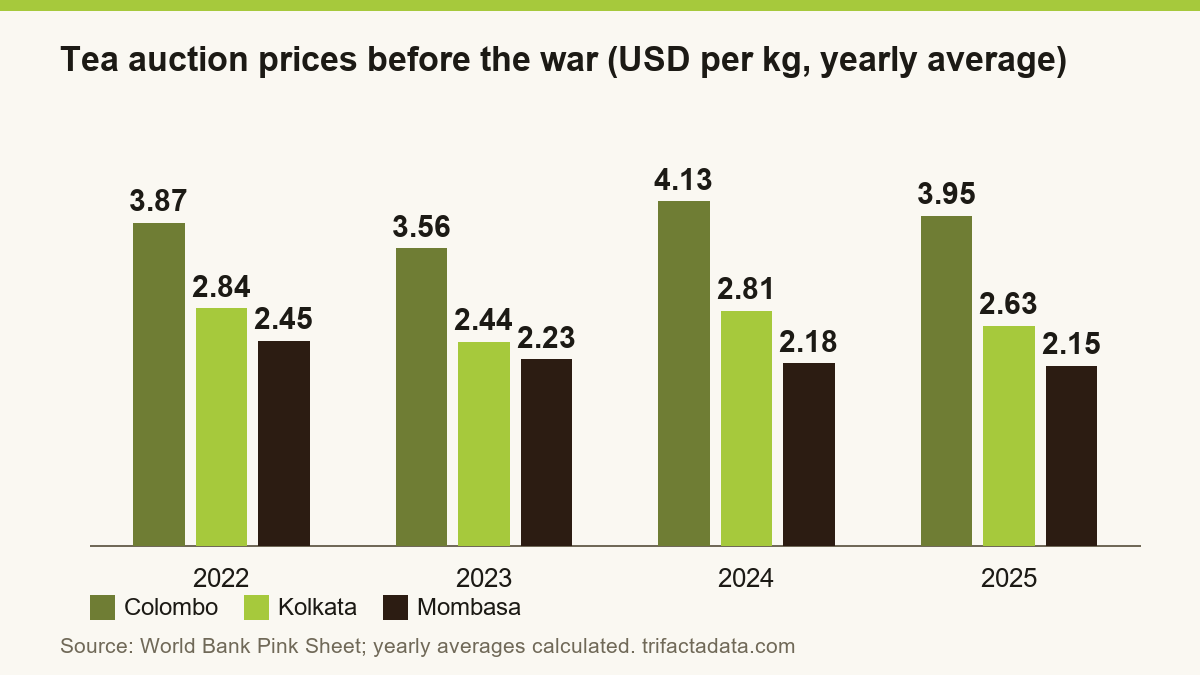
The war arrived when prices were steady. On the World Bank's monthly price data, Colombo teas averaged USD 3.95 a kg in 2025, Kolkata USD 2.63 and Mombasa USD 2.15, close to their 2023 and 2024 levels (yearly averages calculated by Trifacta Data).
Since the war began, the auctions have moved in different directions. In the World Bank's October 2026 data, Colombo prices were lower than a year earlier in every month from January to September, at USD 3.73 a kg in September against USD 4.01 in September 2025. Mombasa fell in May, to USD 2.18, then steadied at USD 2.24 to 2.30, above its 2025 levels. Kolkata rose sharply in May, to USD 3.12 from USD 2.37 in April, when Indian traders reported strong demand for orthodox tea, before easing to USD 2.53 in September. The average of the three auctions was USD 2.85 a kg in September 2026, 2.1% below August and 3.1% below September 2025 (changes calculated by Trifacta Data).
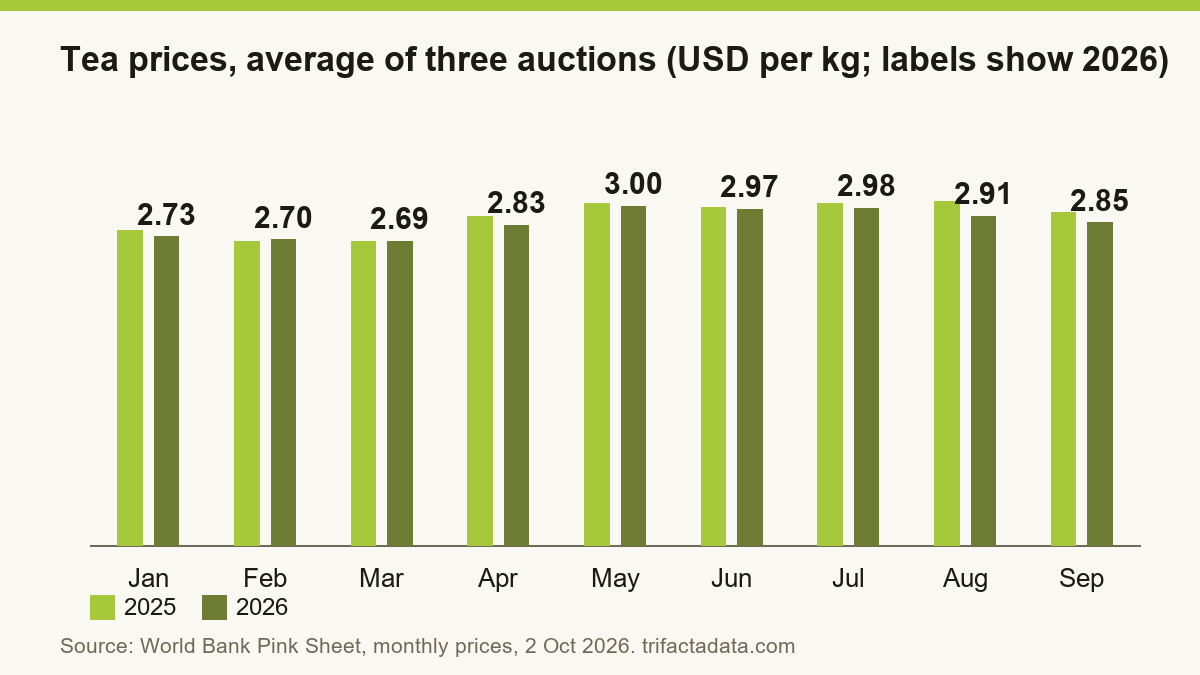
The World Bank's commodity economists explain why prices have not risen overall. In a July 2026 commentary they wrote that the tea market remains well supplied, largely because of rising output in South Asia, including North India and Bangladesh, while weak demand in the Middle East and North Africa is weighing on prices, and that this weakness could persist if shipping through the Strait of Hormuz does not return to normal. They projected tea prices to fall 2% in 2026, after easing 4% in 2025, and to recover gradually in 2027, with risks tilted to the downside, particularly for East African teas.
| Exporter | Exposure to the Middle East | What the 2026 reports show | Source |
|---|---|---|---|
| Sri Lanka | About 52% of tea exports; about 125 million kg in 2025 | Losses of USD 10 to 15 million a week (March); auction fell about Rs 50 a kg; USD 50 million owed by Iran | Tea Exporters Association via Ada Derana, 6 Mar 2026 |
| Kenya | Pakistan about 40% of its tea market; UAE about 20% of leaf tea | KSh 3.1 billion foregone; about USD 8 million a week; exports to Iran -40.7% in Q1 | EATTA via Citizen Digital, 26 Mar 2026; KNBS via Daily Nation, 16 Jul 2026 |
| India | West Asia 46% of tea exports | Q1 exports 54.69 million kg vs 69.24 million; orthodox price Rs 315.26 to 330.61 a kg (Apr to May) | Business Standard via VisionIAS, 3 Jun 2026 |
What happens next depends on how long shipping through the Gulf stays disrupted, whether payments from Iran resume and how sanctions apply. Sri Lanka's exporters asked their government for help with cash flow, freight and insurance costs and the money owed by Iran; Kenya's export agency pointed to African markets under the continental free trade agreement; and Indian sellers were building stock. None of the sources gives a forecast for full-year 2026 exports.
Frequently asked questions
How did the 2026 Middle East war affect tea exports?
Shipping lines suspended services to the Gulf, war-risk insurance lapsed and payments were delayed. Sri Lankan exporters estimated losses of USD 10 to 15 million a week in March 2026, Kenyan tea was left at Mombasa, and Kenya's exports to Iran fell 40.7% in the first quarter.
Which countries buy the most tea from Sri Lanka and India?
In 2025 Iraq was the largest buyer for both: 39.36 million kg from Sri Lanka and 52.59 million kg from India. The UAE was India's second-largest buyer and in Sri Lanka's top five, with Iran also a major buyer.
Did tea prices go up because of the war?
Not overall. Colombo prices fell in the first weeks of the war and stayed below 2025 levels, Kolkata rose in May on strong demand for Indian orthodox tea, and Mombasa steadied after a dip in May. The World Bank's three-auction average was USD 2.85 a kg in September 2026, 3.1% below a year earlier, and it forecasts a 2% fall for 2026.
How much of Sri Lanka's tea goes to the Middle East?
About 52% of its exports, around 125 million kg worth an estimated USD 750 million in 2025, according to the Tea Exporters Association.
Why is Iran a special case for tea exporters?
Iran buys tea from Sri Lanka under a barter arrangement and from Kenya and India, and sanctions complicate payments. Sri Lankan exporters said about USD 50 million was owed for tea already shipped when the war began.
Sources
- Ada Derana Biz, Sri Lanka tea industry may lose USD 10-15 million per week from Middle East war, 6 Mar 2026
- Citizen Digital, Losses hit over Ksh.3 billion as Iran conflict disrupts Kenyan tea exports, 26 Mar 2026
- Daily Nation, Kenya exports to Iran drop 41pc as war disrupts trade, 16 Jul 2026
- VisionIAS (summary of Business Standard), West Asia conflict: trade optimism, supply crisis boost Indian tea demand, 3 Jun 2026
- Daily Mirror (Sri Lanka), Sri Lanka's tea exports cross US$ 1.5bn mark in 2025, 23 Jan 2026
- Asia News Network (The Statesman), India records highest-ever tea exports in 2025, 11 Feb 2026
- Khusoko, Kenya tea export earnings rise to Sh187 billion (Tea Board of Kenya report), 7 Apr 2026
- World Bank, Commodity Price Data (Pink Sheet), monthly prices, updated 2 Oct 2026
- World Bank Blogs, Beverage prices retreat as supplies recover (John Baffes and Kaltrina Temaj), 7 Jul 2026
Related reports
This page is market information, not investment advice. Figures are quoted from the sources linked above and keep their own definitions and currencies: Sri Lankan figures are in rupees or US dollars, Kenyan figures in shillings, Indian figures in rupees and auction prices per kilogram of made tea. Changes marked as calculated are worked out by Trifacta Data from those figures.