China's net imports of polypropylene fell from 6.39 million tonnes in 2020 to 0.57 million tonnes in 2025, according to China's own customs data reported to UN Comtrade, and its purchases of polyethylene and polypropylene from the Middle East fell from USD 10.61 billion in 2021 to USD 6.80 billion in 2025. Yet when attacks on ships in the Persian Gulf rose in late 2026, the main Chinese polypropylene futures contract hit a record high. This page shows how China's trade in the two biggest plastics changed, what the Middle East lost, and why the war still reached Chinese prices. Every figure links to its source.
China has almost stopped importing polypropylene
Polypropylene is the plastic in food tubs, bottle caps, woven sacks, car bumpers and face masks, and China used to import a large part of what it used. Its customs data, reported to UN Comtrade, show imports of polymers of propylene and other olefins (HS 3902) of 5.47 million tonnes in 2019 and 6.84 million tonnes in 2020. By 2025 imports had fallen to 3.73 million tonnes, while exports had risen from 0.45 million tonnes in 2020 to 3.16 million tonnes. Net imports, imports minus exports, fell from 6.39 million tonnes in 2020 to 0.57 million tonnes in 2025 (calculated).
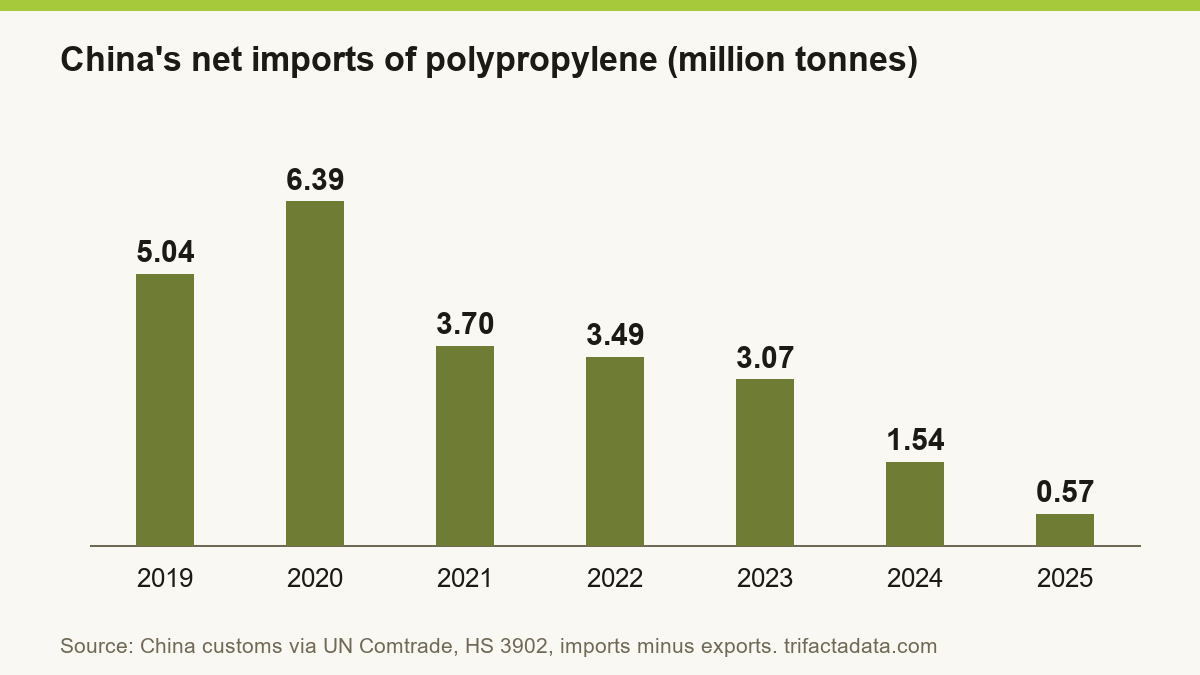
The reason is new capacity at home. A Chinese commodity data firm reported in February 2026 that China added 4.555 million tonnes of polypropylene capacity in 2025, taking the total to 49.165 million tonnes, and that output rose from 29.27 million tonnes in 2021 to 40.22 million tonnes in 2025. Capacity grew faster than output: the same firm put capacity use at 82%, down from a peak of 91%, and the average 2025 price of the main grade at RMB 6,988 a tonne, 7.35% lower than in 2024. A chemical price-reporting agency, counting polypropylene alone, put China's net imports at a peak of 6.1 million tonnes in 2020 and about 300,000 tonnes in 2025, with complete self-sufficiency in homopolymer grades likely soon.
Polyethylene: still a big buyer, but paying less
Polyethylene, the plastic in film, bags, bottles and pipes, is a different story. China still imported 15.87 million tonnes of polymers of ethylene (HS 3901) in 2025, down from a peak of 21.28 million tonnes in 2020, and exported 2.05 million tonnes, up from 0.68 million. Net imports were 13.81 million tonnes in 2025 against 20.60 million in 2020 (calculated). What changed more was the price. China paid an average of USD 1,304 a tonne for its polyethylene imports in 2021 and USD 1,033 in 2025 (customs value divided by weight, calculated). The price-reporting agency put the average of four grades of high-density polyethylene delivered to China at USD 1,120 a tonne in 2021 and USD 866 in 2025.
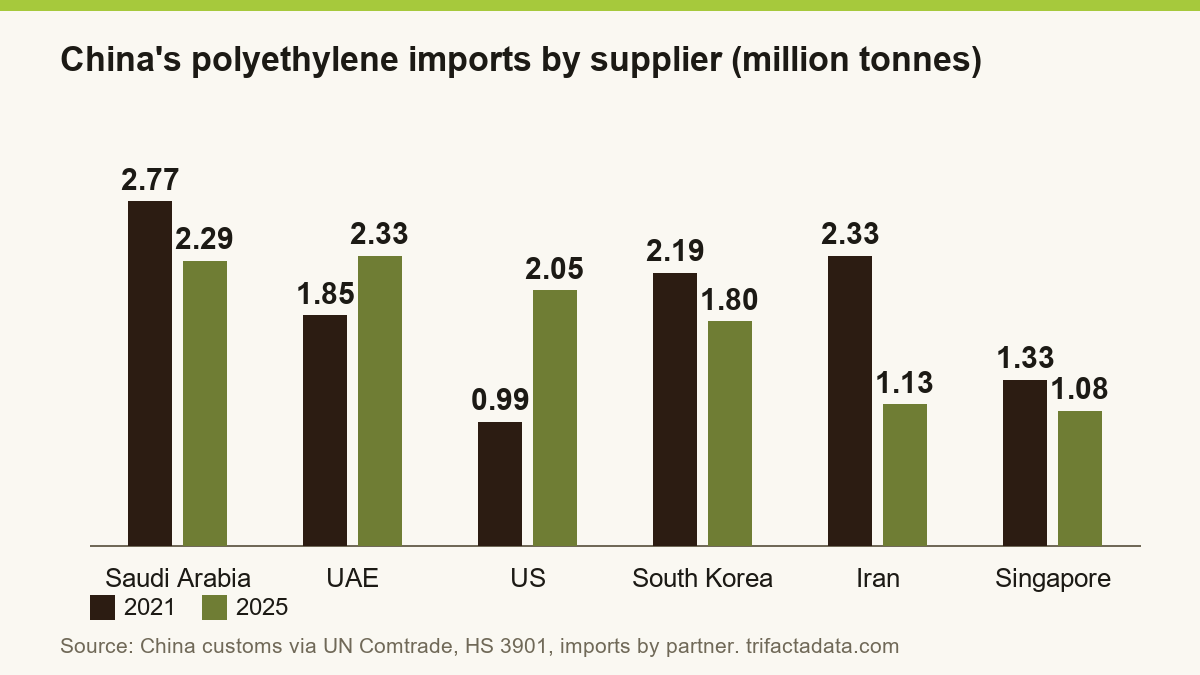
The Middle East is still China's main source. Saudi Arabia, the UAE, Iran, Qatar, Kuwait, Oman and Bahrain together supplied 6.54 million tonnes of polyethylene in 2025, 41% of China's imports, against 47% in 2019 (calculated). But the mix inside the region changed. Iran's sales fell from 2.56 million tonnes in 2019 to 1.13 million tonnes in 2025, while the UAE's rose from 1.49 million to 2.33 million tonnes. The United States, with cheap ethane from shale gas, went from 0.68 million tonnes in 2019 to 2.76 million in 2023 and 2.05 million in 2025.
What the Middle East lost
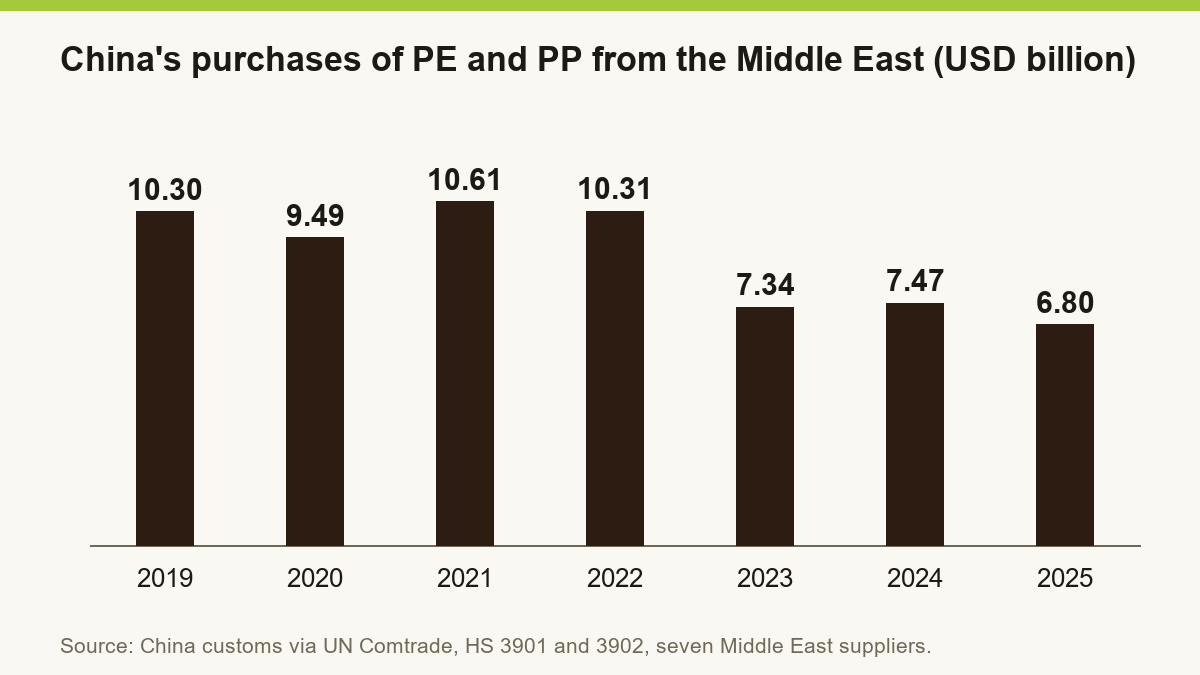
Put together, China's purchases of polyethylene and polypropylene from the seven Middle Eastern countries were worth USD 10.61 billion in 2021 and USD 6.80 billion in 2025, a fall of 36% (calculated from China's customs data). In polyethylene, both volume and price fell: the region sold China 7.93 million tonnes in 2021 and 6.54 million in 2025, and the average price fell from USD 1,175 to USD 956 a tonne (calculated). In polypropylene, volumes fell from 1.38 million tonnes in 2020 to 0.59 million tonnes in 2025. The price-reporting agency estimated that Iran's sales of high-density polyethylene to China were worth USD 856 million less in 2025 than in 2021, and Saudi Arabia's USD 727 million less.
Middle Eastern producers found other buyers. A trade-data firm reported that Middle East exports of the commonest polypropylene grade were 5.5 million tonnes in 2025, nearly half of world exports of 11.5 million tonnes, down from 6.1 million tonnes in 2021 largely because of smaller shipments to China, with Africa and Latin America particularly strong growth markets.
Then the war: why China's prices still jumped
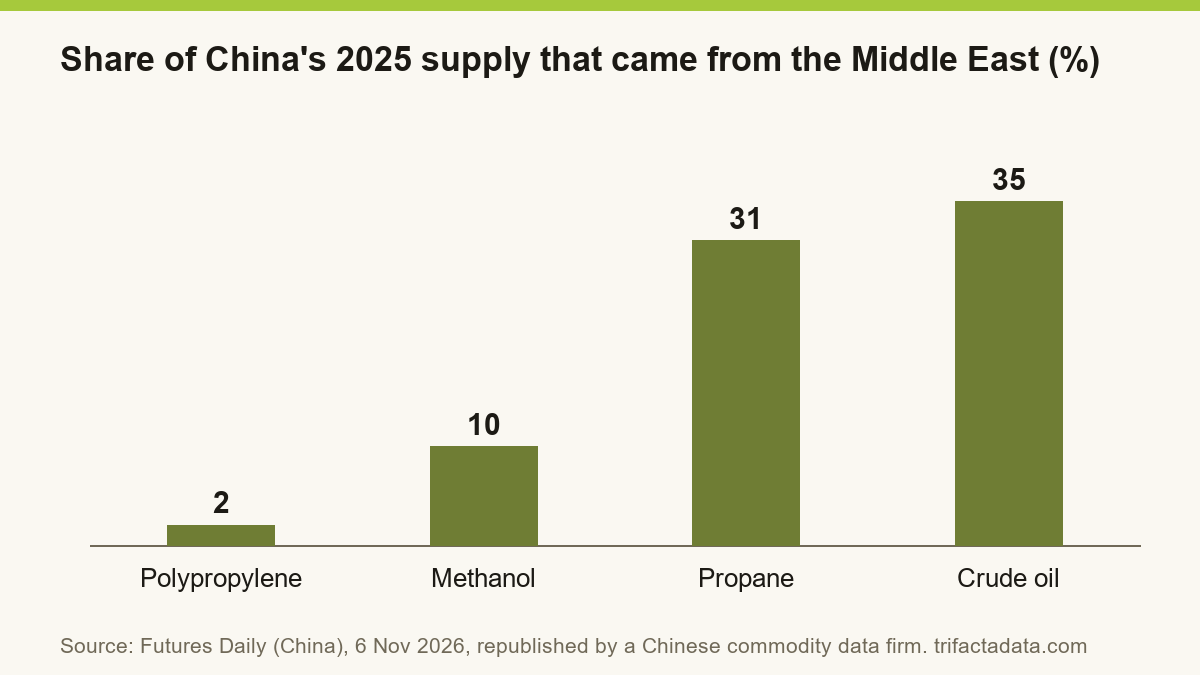
In 2026 the Middle East conflict turned the story around. A November 2026 analysis by China's Futures Daily, republished by a Chinese commodity data firm, said attacks on ships in the Persian Gulf had increased since October, navigation through the Strait of Hormuz had been blocked, and on 2 November the main polypropylene futures contract hit a record high during trading. It also explained why. Middle Eastern sources made up only 2% of China's polypropylene supply, but in 2025 they supplied 35% of China's crude oil, 31% of its propane and 10% of its methanol, the raw materials its own plants use. Coastal plants that make polypropylene from methanol were at one point shut down completely by the methanol shortage, and in early October that route was losing RMB 2,900 a tonne.
Another Chinese commodity data firm reported that the price of polypropylene raffia, the main grade, reached RMB 10,456 a tonne on 9 October 2026, about half as much again as the 2025 average of RMB 6,988 (calculated; the two firms' price series are not identical). The Futures Daily analysis expected China to become a net exporter of polypropylene in 2026.
Outside China: plants offline and higher prices
The war also took Middle Eastern supply out of the market. In its second-quarter 2026 results, LyondellBasell, which makes polyethylene and polypropylene in the Americas, Europe and Asia, said 20-25% of Middle East polyethylene capacity was expected to remain offline through 2026, counting both damaged plants and plants short of feedstock. In its third-quarter results it said US polyethylene prices were USD 0.25 a pound higher year to date, and that the industry's integrated polyethylene margins ended the quarter about 50% above 2025 levels. It also said it expects the market to loosen as supply returns, because structural oversupply persists.
That oversupply is mostly in China. A management consultancy's research institute put China's installed polyethylene capacity at 42 million tonnes in 2025, against 23 million in the Middle East and 34 million in North America, and counted 23 million tonnes of new capacity planned in China between 2025 and 2030, against 6.8 million in the Middle East.
| China's trade (customs data) | 2019 | 2021 | 2023 | 2024 | 2025 |
|---|---|---|---|---|---|
| Polyethylene imports, million tonnes | 19.21 | 17.35 | 16.70 | 16.73 | 15.87 |
| Polyethylene exports, million tonnes | 0.71 | 1.01 | 1.56 | 1.66 | 2.05 |
| Polyethylene import price, USD a tonne (calculated) | 1,077 | 1,304 | 1,184 | 1,104 | 1,033 |
| Middle East share of polyethylene imports (calculated) | 47% | 46% | 38% | 40% | 41% |
| Polypropylene imports, million tonnes | 5.47 | 5.11 | 4.42 | 4.00 | 3.73 |
| Polypropylene exports, million tonnes | 0.43 | 1.41 | 1.35 | 2.46 | 3.16 |
| PE and PP bought from the Middle East, USD billion | 10.30 | 10.61 | 7.34 | 7.47 | 6.80 |
What the data do not show
First, China's customs data for 2026 were not yet available, so the trade figures stop at 2025 and do not show how the war changed China's imports and exports. Second, HS 3902 covers polymers of propylene and of other olefins, so it is slightly wider than polypropylene alone; that is why the price-reporting agency's net import figure for 2025 is lower than ours. Third, import prices are customs values divided by weight and depend on the mix of grades. Fourth, the Middle East shares of China's supply are the Futures Daily's estimates, not official statistics. Finally, the capacity figures are installed nameplate capacity, not output.
Frequently asked questions
Does China still import polypropylene?
Yes, but much less than before. China's customs data show imports of 3.73 million tonnes of polymers of propylene and other olefins in 2025 and exports of 3.16 million tonnes, so net imports were 0.57 million tonnes, against 6.39 million tonnes in 2020 (calculated).
How much polyethylene does China import from the Middle East?
In 2025 China imported 6.54 million tonnes of polyethylene from Saudi Arabia, the UAE, Iran, Qatar, Kuwait, Oman and Bahrain, 41% of its polyethylene imports (calculated from China's customs data). The UAE (2.33 million tonnes) and Saudi Arabia (2.29 million tonnes) were the largest.
Why did polypropylene prices in China rise in 2026 if China imports little?
Because Chinese plants depend on Middle Eastern raw materials. A Futures Daily analysis in November 2026 put the Middle East's share of China's 2025 supply at 2% for polypropylene but 35% for crude oil, 31% for propane and 10% for methanol. When the conflict disrupted those supplies, the cost of making polypropylene rose, and the main futures contract hit a record on 2 November 2026.
How much Middle East polyethylene capacity was offline in 2026?
LyondellBasell said in July 2026 that 20-25% of Middle East polyethylene capacity was expected to remain offline through 2026, including damaged plants and plants short of feedstock.
Sources
- UN Comtrade, China (reporter) imports and exports by partner, HS 3901 and 3902, annual 2019-2025 (read via the public API, 22 November 2026)
- Futures Daily (China), China polypropylene soars on Middle East risks while demand remains sluggish, 6 November 2026, republished by a Chinese commodity data firm
- A Chinese commodity data firm, polypropylene capacity and output, 2 February 2026
- Another Chinese commodity data firm, China PP prices poised to hit new highs, 9 October 2026
- A chemical price-reporting agency, China's HDPE market in 2025 versus 2021, 9 February 2026
- A trade-data firm, trends in polypropylene homopolymer global trade 2021-2025, April 2026
- LyondellBasell, second-quarter 2026 earnings slides, July 2026
- LyondellBasell, third-quarter 2026 earnings slides, October 2026
- LyondellBasell, third-quarter 2026 results release, October 2026
- A management consultancy's research institute, Polyethylene: widely produced but not one-size-fits-all, June 2026
Related reports
This page is market information, not investment advice. Trade figures are China's own customs data as reported to UN Comtrade (imports and exports by partner, annual, read 22 November 2026); values are in US dollars as reported. HS 3901 covers polymers of ethylene (polyethylene and ethylene copolymers) and HS 3902 covers polymers of propylene and other olefins in primary forms, so HS 3902 is slightly wider than polypropylene alone. Net imports are imports minus exports; shares, changes and unit values marked as calculated are worked out by Trifacta Data. 2026 trade data for China were not yet available.