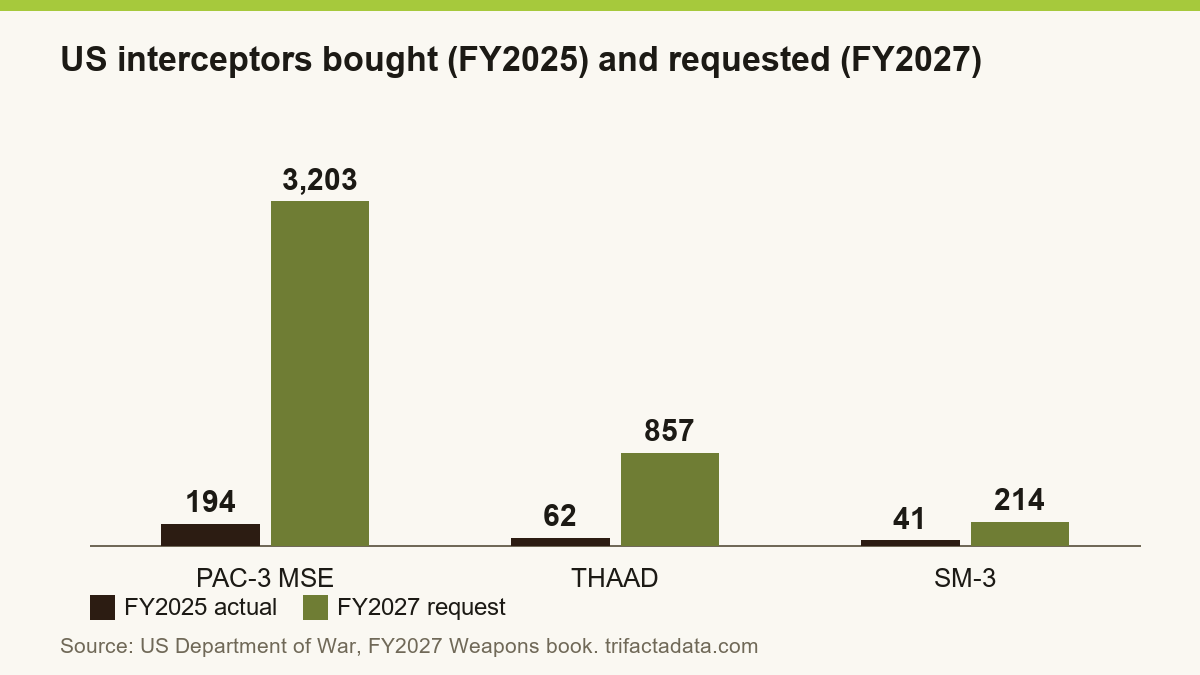
The US Department of War's budget request for fiscal 2027 asks for 3,203 PAC-3 MSE interceptors, 857 THAAD interceptors and 214 SM-3 interceptors, against 194, 62 and 41 bought in fiscal 2025, according to its own FY2027 Weapons book. The dollars for these three programmes rise from USD 3.0 billion to USD 30.9 billion. But USD 27.8 billion of that, 90%, is in the mandatory request, which depends on a reconciliation bill Congress has not passed (our calculation from the budget tables).
What the budget books ask for
Each line of the request is published with a quantity and a cost. For the three main missile defence interceptors, the FY2027 request is about ten times FY2025 in dollars, and the quantities rise even faster for THAAD (14 times) and PAC-3 MSE (17 times). The Weapons book says the PAC-3 request funds 3,203 missiles for the Army and Navy and the second year of a multiyear contract; it also funds the procurement of 857 THAAD interceptors.
The reason is stockpiles. The Center for Strategic and International Studies estimated in November 2026 that about two-thirds of the US Patriot interceptor inventory held before the Iran war, and about half of the THAAD inventory, had been used (CSIS). In the 12-day war of June 2025 alone, JINSA estimated that the United States fired 92 THAAD interceptors, about 14% of its stock.
Nine-tenths of the money is in a bill that has not passed
The FY2027 request is split in two: a discretionary request that goes through the normal appropriations process, and a mandatory request that relies on a budget reconciliation bill. For PAC-3 MSE, THAAD and SM-3 together, USD 27.8 billion of the USD 30.9 billion requested is mandatory (our calculation). For counter-unmanned systems, USD 14.4 billion of USD 20.6 billion is mandatory.
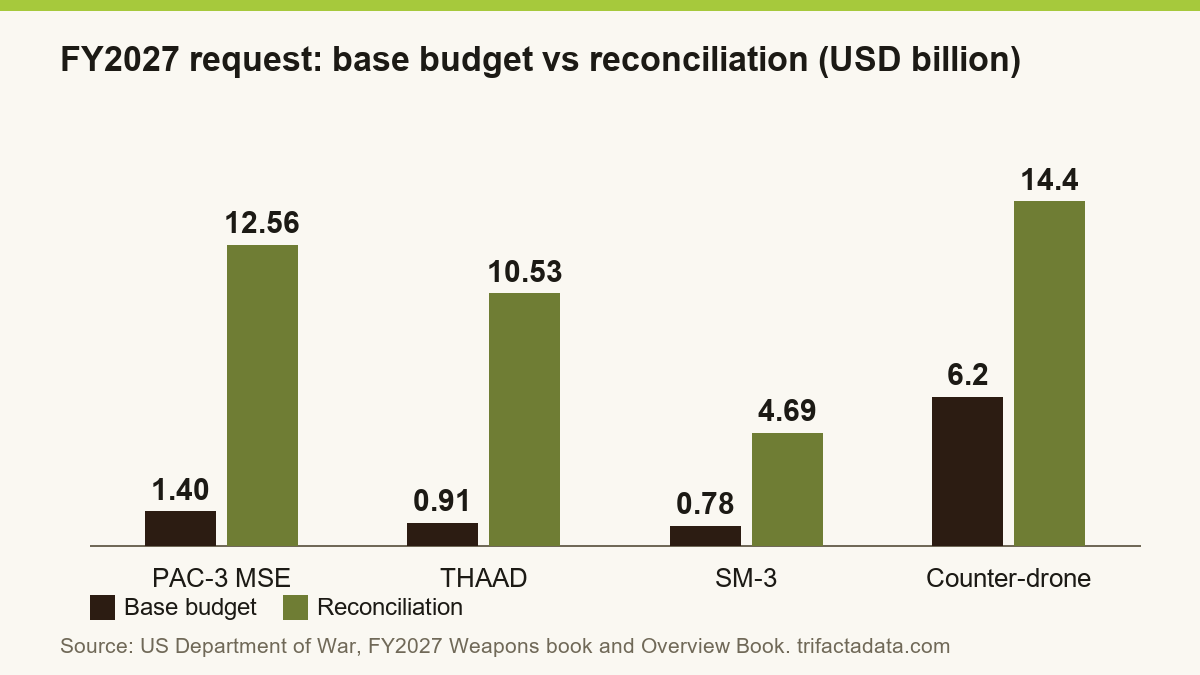
That route is uncertain. A Center for a New American Security report of October 2026 found that across ten priority munitions, 82% of the requested USD 49.5 billion relied on reconciliation, and that in July 2026 a House draft reconciliation bill cut the department's request by 83%. The same report noted that the five-year defence plan then averages USD 26.7 billion a year for these munitions through FY2031.
Can industry build them?
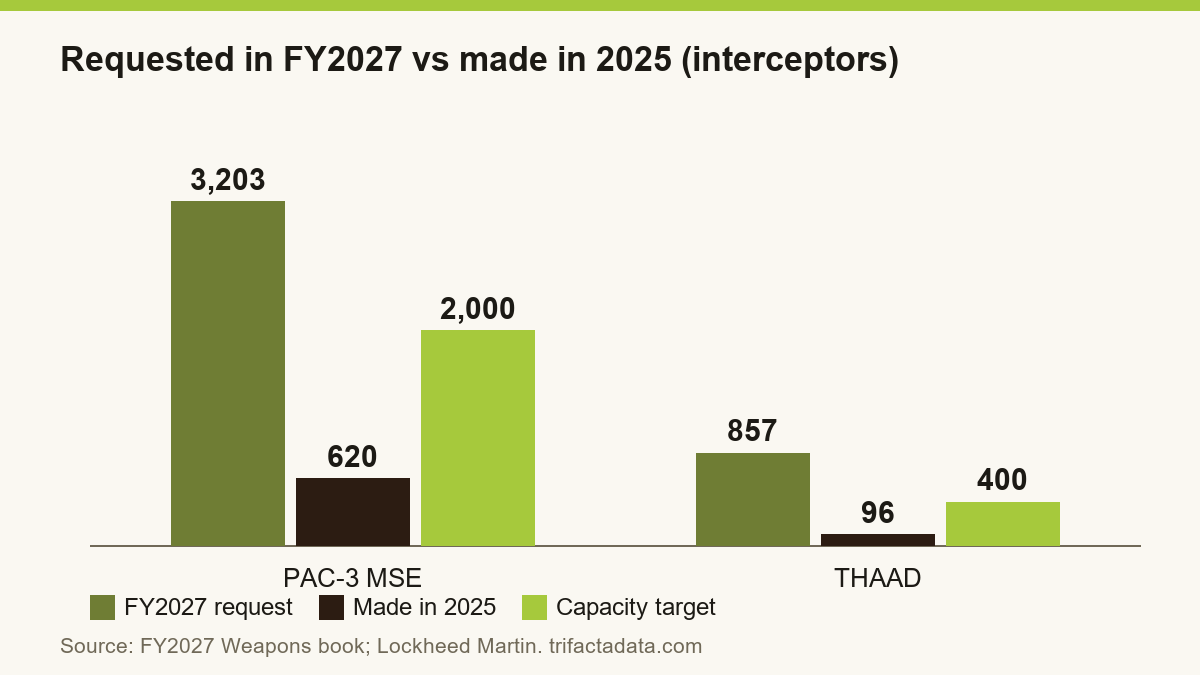
Even if Congress funds the request, factories set the pace. Lockheed Martin delivered 620 PAC-3 MSE in 2025 and agreed a framework to raise capacity to about 2,000 a year over seven years; it agreed another to raise THAAD output from 96 to 400 interceptors a year. At the 2025 rate, the FY2027 THAAD request equals about nine years of production (our calculation). Raytheon agreed frameworks to raise SM-6 output to more than 500 a year and to increase SM-3 production (RTX).
| Programme | FY2025 actual | FY2026 | FY2027 request | Of which mandatory |
|---|---|---|---|---|
| PAC-3 MSE | 194 / USD 905m | 357 / USD 1,646m | 3,203 / USD 13,960m | 2,936 / USD 12,565m |
| THAAD | 62 / USD 955m | 55 / USD 823m | 857 / USD 11,435m | 830 / USD 10,528m |
| SM-3 IB and IIA | 41 / USD 1,102m | 54 / USD 1,335m | 214 / USD 5,464m | 192 / USD 4,685m |
| Counter-unmanned systems | USD 2,247m | USD 3,900m (enacted) | USD 20,600m | USD 14,400m |
What the data do not show
Requests are not budgets: Congress can change quantities and funding routes, and appropriations for FY2027 were not final when this was written. Procurement dollars include support costs, so they cannot be divided into a simple price per missile. PAC-3 output in 2025 includes interceptors for allies, which are paid for through other routes. The CSIS and JINSA stockpile figures are estimates.
Frequently asked questions
How many PAC-3 MSE interceptors does the FY2027 budget request?
3,203 for the Army and Navy, at a cost of USD 13.96 billion, of which 2,936 interceptors (USD 12.56 billion) are in the mandatory request.
How many THAAD interceptors does the FY2027 budget request?
857 for USD 11.44 billion, of which 830 are in the mandatory request, against 62 bought in FY2025.
What is the mandatory or reconciliation request?
It is the part of the FY2027 request that depends on a budget reconciliation bill rather than the regular appropriations process. For PAC-3 MSE, THAAD and SM-3 together it is about 90% of the money requested.
How much does the FY2027 budget request for counter-drone systems?
USD 20.6 billion for counter-unmanned systems, against USD 3.9 billion enacted in FY2026, with USD 14.4 billion in the mandatory request.
Sources
- US Department of War, FY2027 Program Acquisition Cost by Weapon System (Weapons book)
- US Department of War, FY2027 Budget Request Overview Book
- US Department of War, FY2026 Budget Request Overview Book
- Lockheed Martin, PAC-3 MSE framework agreement, 6 Jan 2026
- Lockheed Martin, THAAD framework agreement, 29 Jan 2026
- RTX, five framework agreements, 4 Feb 2026
- CNAS, Munitions procurement and the FY2027 defense budget, Oct 2026
- CSIS, Munition inventories: an update amid renewed war risk, 10 Nov 2026
- JINSA, missile and interceptor cost estimates during the US-Israel-Iran war, 21 Jul 2025
Related reports
This page is market information, not policy or investment advice. All budget figures are from the US Department of War's FY2027 budget books as published; FY2025 figures are actuals and FY2027 figures are requests that Congress has not yet enacted. Percentages are our calculations.