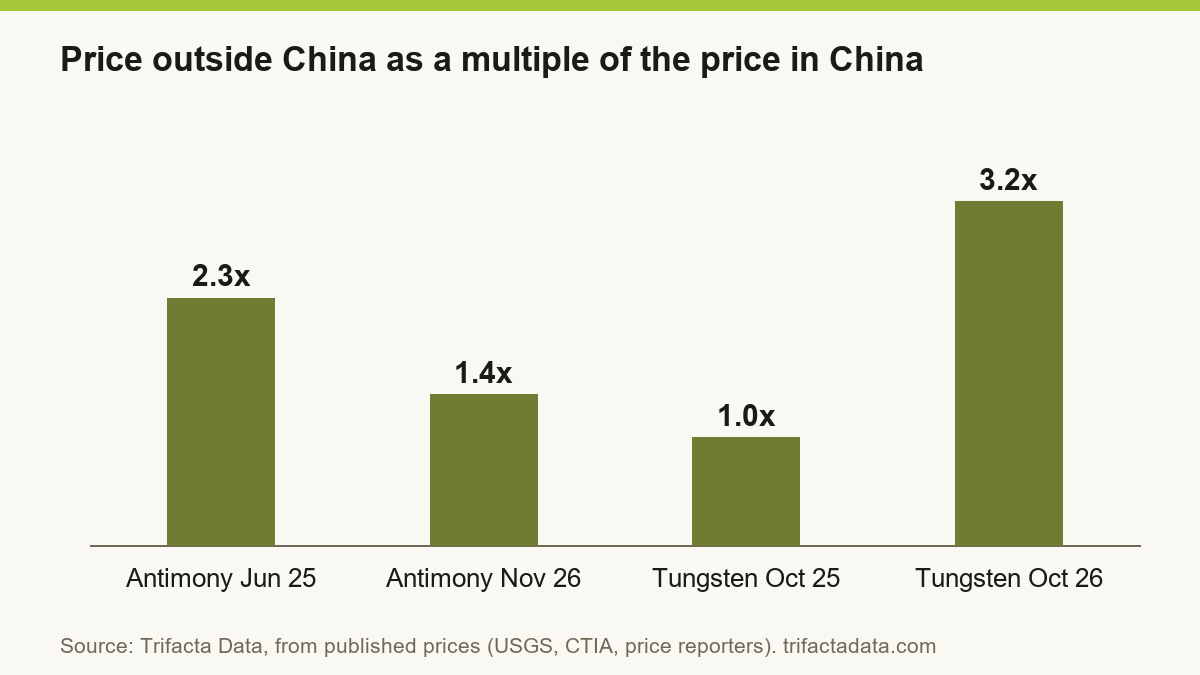
Since China put export controls on antimony and tungsten, each metal has traded at two prices: one inside China and one outside it. In June 2025 antimony cost 2.3 times as much outside China as inside. By October and November 2026 that gap had narrowed to about 1.2 to 1.4 times, while tungsten, which cost about the same in Europe and China in October 2025, cost 3.2 times as much in Europe a year later (our calculation from the published prices linked below). Several January 2027 deadlines could move both gaps again.
How one market became two
Both metals are mined mostly in China. The US Geological Survey puts China at 67,000 of the 85,000 tonnes of tungsten mined in 2025, and at 40,000 of the 110,000 tonnes of antimony (USGS), and China also imports antimony ore and concentrate to process: 32,655.5 tonnes in January-November 2025, according to a Chinese commodity data firm. China introduced export licences for antimony in 2024 and banned exports to the United States in December 2024; it put controls on selected tungsten products in February 2025, after the United States raised tariffs on Chinese tungsten products, according to the USGS.
Licences slow exports without stopping them. When less metal leaves China, buyers outside China compete for what is left and prices outside China rise, while metal inside China stays cheaper. The chart below divides the price outside China by the price inside China at four points.
Antimony: the gap opened in 2025 and is closing
In June 2025 the international antimony price was USD 27.50 per pound, or about USD 60,630 per tonne (USGS), and European prices reached a record of about USD 59,750 per tonne in July, according to a price-reporting agency. In China, a Chinese metals data firm put the No.1 ingot at RMB 186,500 per tonne on 20 June 2025, about USD 25,960 at the 2025 average exchange rate.
China suspended its US antimony ban in November 2025 (a price-reporting agency), and prices outside China fell. By 14 October 2026 European antimony was USD 18,300-19,000 per tonne, against RMB 100,000-103,000 (USD 14,943-15,392) in China (a price-reporting agency). On 16 November China's ingot price was RMB 87,250 (a Chinese commodity data firm), and on 5 November the international spot price was USD 8.16 per pound, about USD 17,990 per tonne.
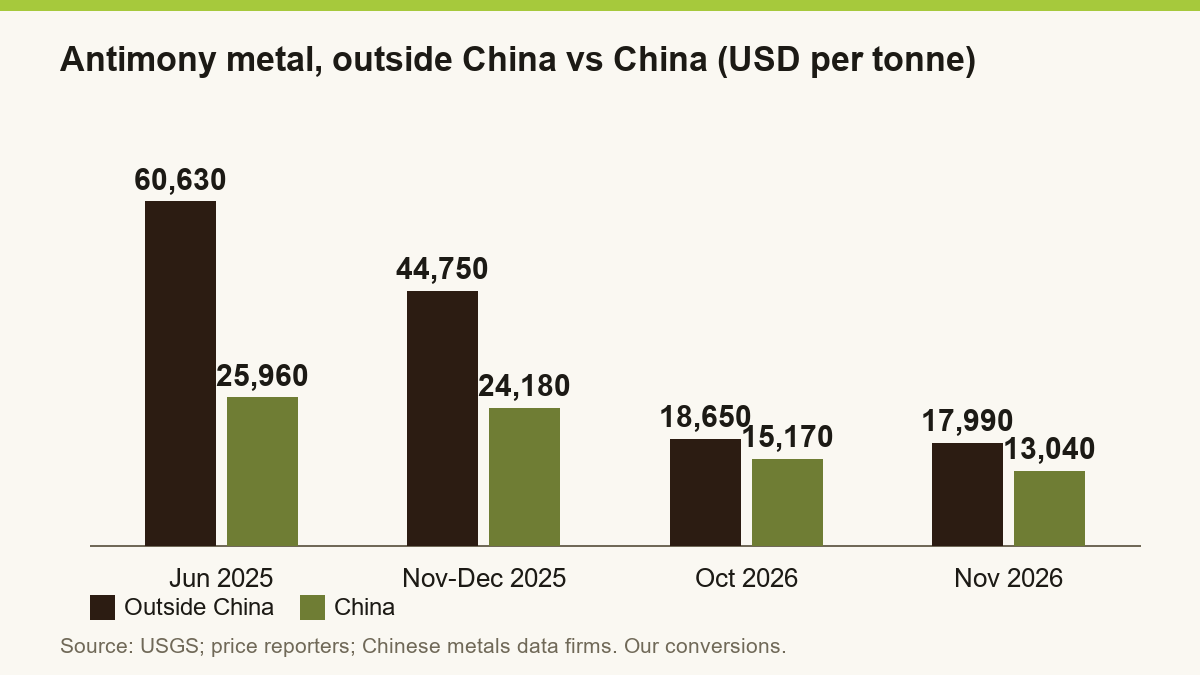
The agency's 2026 outlook reported that the high prices drew new smelters into the market and suppressed some demand, and that market participants expected the gap between Chinese and international prices to keep narrowing.
Tungsten: the gap opened in 2026, and it is wide
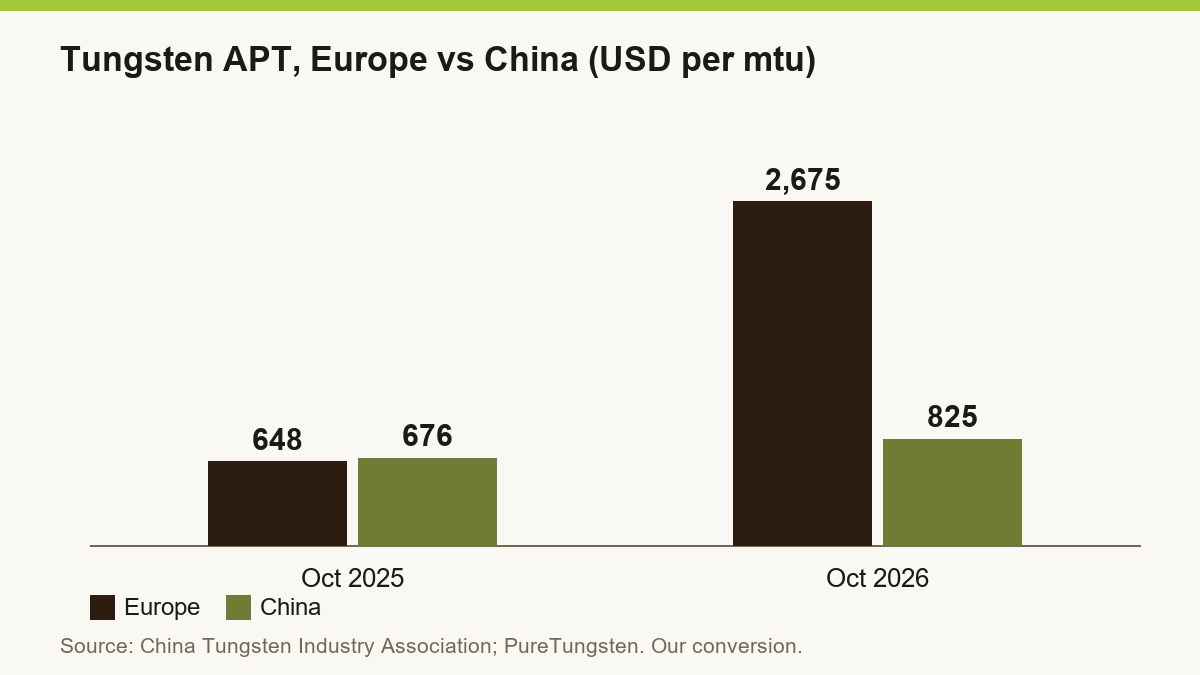
In October 2025 European and Chinese tungsten prices were close. The China Tungsten Industry Association reported Chinese domestic APT at RMB 430,000 per tonne and European APT at USD 610-685 per mtu on 29 October 2025, roughly the same price once converted (our calculation; one tonne of APT holds 88.5 mtu).
In 2026 the two split. A price-reporting agency reported that Chinese tungsten concentrate set an all-time high of RMB 1.0-1.05 million per tonne on 11 March 2026 and had halved by late June, while concentrate outside China held at USD 2,500-2,800 per mtu from 29 May. Chinese APT fell about 69% from its March peak by mid-October, according to PureTungsten, which put European APT at about USD 2,500-3,100 per mtu in late October and Chinese APT at about USD 800-850.
Exports show why. China's exports of tungsten products fell 23.47% to 9,946 tonnes in January-October 2026, and exports of APT, the main intermediate, fell 80.76% to 42.8 tonnes, according to China Tungsten Industry Association figures compiled from customs data. Exports of tungsten carbide rose 14.9%.
January 2027: four dates to watch
| Date | What happens | Metal |
|---|---|---|
| 7 December 2026 | First Western tungsten futures planned on CME (Discovery Alert) | Tungsten |
| 1 January 2027 | US defence contractors may no longer deliver tungsten mined or processed in China, Russia, Iran or North Korea (PiQ Markets) | Tungsten |
| 10 January 2027 | China's pause of its October 2025 export controls ends, unless extended (a Chinese metals data firm) | Rare earths, graphite anodes |
| 27 January 2027 | China's pause of its US ban on antimony, gallium and germanium ends, unless extended (CASRAI) | Antimony |
The US government has signed tungsten deals worth up to USD 2.45 billion in 2026, including a defence stockpile contract with a USD 2 billion ceiling (PiQ Markets). Licensing and the ban on exports for US military use stay in force during China's pause on antimony, gallium and germanium, as reported by Tech Times.
What the data do not show
The prices are spot benchmarks for specific grades and places, and actual contract prices can differ. The multiples compare different products in the two markets (international metal against China ingot for antimony, European APT against Chinese APT for tungsten) at the dates stated, and the October 2025 tungsten comparison uses the 2025 average exchange rate. Full-year 2026 averages will not be available until early 2027.
Frequently asked questions
Why is tungsten more expensive in Europe than in China?
Because China mines most of the world's tungsten and has restricted exports since February 2025, buyers outside China compete for less metal. In late October 2026 European APT was about USD 2,500-3,100 per mtu and Chinese APT about USD 800-850 (PureTungsten).
Has the antimony price fallen?
Yes. The international price averaged USD 25 per pound in 2025 (USGS) and was USD 8.16 per pound in November 2026, after China suspended its US export ban in November 2025.
When does China's antimony export ban suspension end?
China extended the suspension of its US-specific ban on antimony, gallium and germanium exports to 27 January 2027, while keeping export licences and the ban on US military users.
What is the Pentagon tungsten ban?
From 1 January 2027 US defence contractors may no longer deliver tungsten mined, refined or separated in China, Russia, Iran or North Korea.
Sources
- USGS, Mineral Commodity Summaries 2026, Antimony
- USGS, Mineral Commodity Summaries 2026, Tungsten
- United States Antimony, investor presentation, Dec 2026
- A price-reporting agency, Antimony 2026 outlook
- A price-reporting agency, Europe's antimony market, Oct 2026
- A price-reporting agency, China suspends export prohibition to the US, Nov 2025
- A Chinese metals data firm, antimony prices in H1 2025, 11 Jul 2025
- A Chinese commodity data firm, antimony ingot market 1-16 Nov 2026
- A Chinese commodity data firm, antimony ingot market Dec 2025
- China Tungsten Industry Association, prices on 29 Oct 2025
- China Tungsten Industry Association, China tungsten exports Jan-Oct 2026
- A price-reporting agency, tungsten markets fragmenting, Jun 2026
- PureTungsten, tungsten price 2026
- Discovery Alert, tungsten price split, Nov 2026
- PiQ Markets, US tungsten deals ahead of the Pentagon ban
- A Chinese metals data firm, China extends suspension of export controls to January 2027
- CASRAI, China extends gallium, germanium and antimony suspension to 27 Jan 2027
- Tech Times, China extends export ban pause, 25 Nov 2026
Related reports
This page is market information, not investment advice. Prices are published benchmarks from the sources linked; China prices are converted to US dollars at the rates stated and include China's own taxes as quoted. The multiples are our calculation.